Showing posts with label Episcopal Ecological Network. Show all posts

Thursday, July 12, 2012

Good Weather for Proverbial Elephants

General Convention, 2012

The General Convention of the Episcopal Church ended today. Several resolutions supportive of environmental concerns passed: one opposed fracking  (correction: this did not pass the House of Deputies), another calls for study of genetically modified food crops, while others authorized daily prayer for all seasons. (The Episcopal Ecological Network will be listing all these resolutions for reference in coming weeks.) With the fifth of the Anglican Marks of Mission being “to strive to safeguard the integrity of creation and sustain and renew the life of the earth”, this year’s budget includes $500,000 for that work. Overall, the care of God’s creation received some thoughtful consideration, some funding, and was one of many topics of this convention.

I arrived in Indianapolis Saturday afternoon, when the temperature was somewhere around 105 degrees. Extreme heat and drought were evident every time people stepped outside the convention center and the network of skyways connecting it to hotels. Flying into Indianapolis, I was shocked at the parched, light brown appearance of fields. Several Nebraskans who had driven to Indianapolis told about the poor condition of some of the cornfields they had driven past in Illinois and Indiana, with the leaves of the corn plants curled up in the heat. Yet despite the extreme heat and drought of this summer, and despite the conversations around the specific bits of environmentally related resolutions and budget items, most of the time in the convention center it was easy to forget about environmental degradation of any sort. The plain truth is that for most Episcopalians, environmental issues are not a central concern. Global warming seemed a bit like the proverbial elephant in the middle of the room (or the convention hall): everyone was aware of its presence on some level, but it was seldom mentioned. Even those of us who are intellectually certain that global warming is happening act much of the time as if nothing unusual is happening; we accept global warming intellectually but not existentially.

The record heat we have experienced for several months now is finally helping people get a sense of the meaning of global warming – this worldwide and long-term climate trend that will have deep economic and cultural impacts. The evening newscasts on July 10 on ABC, NBC, CBS, and PBS all made the connection between greenhouse gases and this summer’s heat wave. (See Every Network Gets Extreme Weather Story Right… by Joe Romm.) Denial is becoming less of an option.

In recent years, the church's environmental work has been concentrated on traditional stewardship -- e.g. "greening" our churches, meetings, and homes. While that remains important work, the reality is that these traditional conservation measures practiced by parishes and some of the individuals who worship in them will not stop climate change, which is well underway with lots of feedback loops assuring it will continue. At best, they will mitigate climate change, making its impact less severe than it might have been, or reinforcing the impact of any governmental policies that might come along to address global warming.

Given the reality of climate change caused by global warming, the church has a much deeper task ahead. Secular environmental groups, government, and industry can lead in traditional conservation practices as well as establishing political and economic policies that can do much more to mitigate global warming, but faith communities are uniquely able to work on humankind’s deeper needs during this time.

One task for the church is to help us name and get past the existential denial that keeps us from really seeing that big, hot elephant in the middle of the room. When the church meets at General Convention or at the diocesan or parish level and plans for the future without accounting for the reality of that future, we are in deep denial. Along with addressing denial, the church needs to be prepared to help people through the spiritual crisis that looms ahead as the reality of our situation becomes more evident to more and more people. Finding hope (which will look different from our old hopes) and learning how to lead meaningful and faithful lives as humankind faces a completely new type of challenge is the task of the church now.

God’s creation is still all around us. There are still wonders to behold, the marvels of the web of life, sunrises and sunsets, rainbows, and stars. Renewing our spiritual connection with the earth is a piece of the search for hope and meaning as the fragility of so much of what we take for granted becomes apparent. Our meditations and prayers can reflect both sides of our reality: the beauty of the earth and the unknown future of life on earth.

Friday, July 6, 2012

Environmental Ministry at General Convention


It’s 103 degrees this afternoon in Indianapolis, where the General Convention of The Episcopal Church is underway. I’m on my way there to connect with the Episcopal Ecological Network (EpEN) www.eeonline.org . The incredible heat should provide a good talking point!

Several resolutions touch on environmental issues. The EpEN website shows a list of General Convention resolutions  related to environmental issues. In the exhibit hall, EpEN is sharing a booth with the Episcopal Network for EconomicJustice (ENEJ). Our sharing of physical space is a sign of how issues of economic justice and eco-justice issues are interwoven. Concern for God’s creation because it matters to God is part of our Christian commitment to environmental integrity; the effects of environmental degradation on the poorest people in the world is another major piece of that commitment.

A climate justice resolution and an Episcopal News Service story, Standingwith Kivalina at the 77th General Convention, shows the connections for a community above the Arctic Circle, who in turn ask us to make the connection for indigenous cultures throughout the world.


Tuesday, June 5, 2012

Prayers for World Environment Day


Seeking an End to Poverty and Environmental Destruction

In observance of World Environment Day, Mike Schut (Economic and Environmental Affairs Officer of the Episcopal Church) and the Episcopal Ecological Network have sent on a link to prayers for World Environment Day 2012  from the Southern African Faith Communities’Environment Institute (SAFCEI).  The prayers include petitions for social and economic justice, concerns that are intertwined with our concern for the environment; for peace through justice; for better governance and leaders who follow “spiritual and ethical guidelines”.

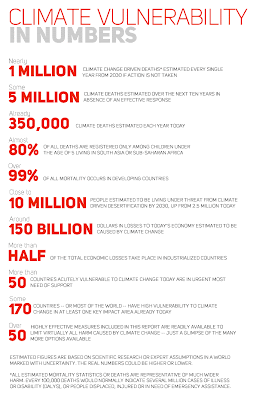
The disaster relief agency DARA provides a chart summarizing the need for prayers and action; especially telling is the heart-breaking report of who has been the most vulnerable to climate change in recent years.  

See 
http://daraint.org/climate-vulnerability-monitor/climate-vulnerability-monitor-2010/in-numbers/

According to this chart, as of 2010 there were already 350,000 deaths per year attributable to climate change. Of those deaths, nearly 80% were registered among one population: children under the age of 5 living in South Asia or Sub-Saharan Africa. Links next to the chart provide more statistics about where we have been and where we are expected to go in this century. From 2030 on, there are one million deaths per year expected, along with “several million cases” each year of illness or disability, or people displaced, injured, or in need of emergency assistance.

The prayers from SAFCEI  include a prayer for Rio+20 written by the Anglican Archbishop of Capetown, Thabo Makgoba.  The Rio+20 Conference is the UN Conference on Sustainable Development that will be held in Rio de Janeiro on June 20-22. The aim of the conference to find agreement on a range of measure that can reduce poverty while promoting decent jobs, clean energy, and a more sustainable and fair us of resources. (In the church, we might call this a stewardship conference.) The conference website says “Rio +20 is a chance to move away from business-as-usual and to act to end poverty, address environmental destruction and build a bridge to the future.”

The offering of many prayers for the world’s leaders to seek and find ways to end poverty and address environmental destruction is a good practice this month and every month!


Thursday, October 29, 2009

Truly Alive

The Gospel lesson for All Saints Day this year is the end of the story of the raising of Lazarus (John 11: 32-44). After Jesus calls to Lazarus, who comes out of the tomb still bound with burial cloths, the story ends with Jesus saying “Unbind him, and let him go.”

I’ve been thinking about what binds us as individuals, parishes, dioceses, and a society. What are the norms and expectations that keep us from flourishing, truly living, as we might? In particular, what binds us and makes it so difficult to accept and begin to make the changes needed to deal with pollution and climate change?

Chuck Morello of the Episcopal Ecological Network (EpEN) sent out a message this week that originated with Skip Vilas of the Diocese of Newark, a founder of EpEN and member of the EpEN leadership team. (Click on Episcopal Ecological Network above or under Good Green Resources in the right hand column of this blog to see more about the network and to sign up for e-mail updates from EpEN.) The message was about an article entitled “Dr. Rowan Williams says climate crisis a chance to become human again” that appeared in The Guardian on October 13.

In this article, Rowan Williams, the Archbishop of Canterbury, suggests an answer to the question of what binds us. In an address at Southwark Cathedral, the Archbishop said that we have allowed ourselves to become “addicted to fantasies about prosperity and growth, dreams of wealth without risk and profit without cost”.

When our primary focus shifts from Christian discipleship to quick and easy ways to build or hold onto wealth, we bind ourselves with self-centeredness, love of money, and conformity to the marketplace. These things are binding or restricting because they keep us from doing what our deeper, better selves long to do: following Christ and living in a way that is fitting for people whose primary identity is Christian discipleship.

Changing the way we live so that life as we know it on this planet can continue for future generations does more than benefit the environment and, in turn, the people who stand to suffer if environmental deterioration goes unchecked. It also helps us to create better lives for ourselves, lives centered on values that nourish our souls. Rowan Williams says: "If I ask what's the point of my undertaking a modest amount of recycling my rubbish or scaling down my air travel, the answer is not that this will unquestionably save the world within six months, but in the first place it's a step towards liberation from a cycle of behaviour that is keeping me, indeed most of us, in a dangerous state — dangerous, that is, to our human dignity and self-respect."

Our lessons for All Saints Day also include Psalm 24. Remembering the first verse of this psalm, “The earth is the Lord’s and all that is in it, the world and all who dwell therein”, can help free us to be good stewards of our planet. We are free to follow Christ and live fully into our humanity when we remember that God created us and the world in which we live, and that the fullness and flourishing of our lives depends on staying in a whole and healthy relationship with God and with God’s creation.

In the end, making the changes we know we need to make is a good thing not only – and possibly not even principally – because it is good for “the Earth” in the abstract or even for our fellow creatures, human and nonhuman, who stand to suffer the most from environmental deterioration, but because it is necessary for the health and vitality of our own souls.

Monday, July 6, 2009

GC Resolutions and Garden Varieties

The Episcopal Church’s 76th General Convention is beginning this week. The Convention will address several important topics, including the environment. Resolutions concerning the environment are listed and summarized on the Episcopal Ecological Network (EpEN). These resolutions range from calls for better environmental stewardship to the development of a liturgical Pentecost Season Creation Cycle to establishment of an Environmental Commission.

Apart from a growing awareness among Americans in general of the practical necessity of taking better care of our environment, there are reasons for Christians in particular to pay more attention to the care of creation. Some of these reasons have to do with the way environmental issues fit into our traditions of being intentional about stewardship of God’s gifts to us and of advocating for policies that help people living in poverty, who are the people most affected by pollution and climate change; other reasons have to do with the way being in touch with the natural world helps to ground and enrich us spiritually. The variety of environmental resolutions for General Convention reflect this range of reasons for us to be more aware of our relationship with the environment. Uniting them all is this: our understanding of God is Incarnational; there is no great divide between body and spirit.

However, we do tend to create dichotomies when we use various categories to try to understand something complex. In this case, we might group the resolutions about environmental stewardship and justice under the category of compassionate action, and group the ones about spirituality under the category of contemplation. Many religious thinkers have explored the supposed dichotomy between action and contemplation; the Letter of James explores a similar dichotomy between works and faith.

This dichotomy came to mind this week as my travels took me to two very different garden projects in two parishes in very different settings. The first was the new flower garden at St. Mary’s in Bassett. I was in Bassett last Monday evening for their Celebration of New Ministry, and stayed overnight at the hotel across the street from the church. Early Tuesday morning, I spent some time sitting on a bench looking at the garden. It was a lovely place to sit, meditate, and feed my spirit at the beginning of the day: a contemplative garden.

The second parish garden I saw was this Sunday at St. Paul’s in Akron, Ohio, where I was confirmed and where my mother is still a parishioner. While St. Paul’s has some beautiful flower gardens, there was a new garden that surprised and delighted me -- a very well-tended vegetable garden. The purpose of this garden is to produce fresh vegetables to share with people who need food for their bodies: an action garden.

While the flowers at St. Mary’s and the vegetables at St. Paul’s seem like two entirely different projects, they have a lot in common. Both give the people who tend them an opportunity to be outdoors and get grounded in the truest sense of the word, by working with the ground. Both suggest good alternatives to grassy areas that need to be mowed and are often maintained with lots of chemical fertilizers, herbicides, and pesticides. Both remind us that something important in the life of a parish can occur on the outer side of the church walls, that our lives as Christians aren’t contained within the indoor worship space. Both give people walking by a reminder of God’s gifts to us, and especially of the gift of new growth and fruition.


In my own garden at home in Nebraska, I tend to mix vegetables and flowers, partly because of lack of space, partly because of my personal taste in landscape aesthetics, but also because I have learned that planting flowers among vegetables – companion planting -- can help keep the vegetable plants freer of pests. Companion planting might be a good metaphor for good Christian discipleship, combining spiritual groundedness with compassionate action.

As I understand the General Convention theme of Ubuntu, it involves the idea of the interconnectedness among all of humankind and all of Creation. Sometimes things that seem very different are really interconnected or even intertwined. James says that faith without works is dead, yet we also know that works or action are more fruitful and lasting when they are grounded in a solid spiritual foundation. In the end, they are not really different things, but just two sides of faithful Christian discipleship.