Showing posts with label poverty. Show all posts

Saturday, July 20, 2013

Compassion for Us All

Proper 11C: Amos and Martha and Mary

Hear this, you that trample on the needy, and bring to ruin the poor of the land, saying, “When will the new moon be over so that we may sell grain; and the sabbath, so that we may offer wheat for sale? We will make the ephah small and the shekel great, and practice deceit with false balances, buying the poor for silver and the needy for a pair of sandals, and selling the sweepings of the wheat.”… I will turn your feasts into mourning, and all your songs into lamentation; I will bring sackcloth on all loins, and baldness on every head; I will make it like the mourning for an only son, and the end of it like a bitter day. (Amos 8:4-6, 10)

Sunday’s reading from Amos (Amos 8:1-12) does not describe the people with power and money in Amos’s time in a flattering way. They walked all over poor people in order to advance their own enterprises. Far from enjoying the opportunity for rest and joy in God’s creation on the Sabbath, they were impatient for it to end so that they could get back to selling wheat and making money. While they followed the letter of the law by not working on the Sabbath, their hearts were centered on their wealth rather than God.

When we look at the people Amos describes as a group, it’s hard to find any compassion for them. They sound like arrogant, self-centered people who think their agenda is more important than the lives of those who have less than them and even more important than God and God’s commandments. But I wonder what it was like to be one of these people. A child growing up in a family and a community that has unholy priorities will learn the same twisted values as the generation before. Someone wanting to make a living and have a comfortable enough life could easily have gotten caught up in business practices that oppressed the poor out of fear that not participating in the same deceitful practices as others might put them at a disadvantage in the marketplace. Close attention to God’s word could have reminded people that their way of life was sinful, but the system that encouraged all of this taught people to care for the acquisition of wealth more than the word of God. Only those like Amos who managed to stay spiritually awake and focus on God’s could see this oppressive system for what it was. While everyone going along with the system could and ultimately would be held morally responsible for their actions, most of us know all too well how easy it would be to go along to get along.

Even while seeing from a distance how wrong this way of life was, we can then have some degree of compassion for them. If we are honest with ourselves, we can see that our own situation has a lot in common with theirs, giving us reason to feel empathy for these ancient people and reason to reflect on changes we need to make here and now.

Our culture holds up prosperity and comfort as ideals. A perfunctory practice of Christianity that ignores most of the teachings of the Gospel is encouraged in an attempt to support the pursuit of wealth and jingoism.

Just as poor people in Amos’s time suffered because of the pursuit of wealth by the powerful, the poorest people in today’s world suffer because of our pursuit of wealth. Greenhouse gas emissions, most of them historically from the wealthiest countries, have already produced enough warming to cause drought, record heat, epic flooding, and sea level rise that affects people in other places right now. Some people worry about climate change because of the effects it could have on their grandchildren, and that’s a legitimate and serious concern. But in many parts of the world, the suffering has already begun for other people’s children and grandchildren, and for adults whose seasons for planting and harvest have been disrupted, whose homes have been destroyed by floods, high winds, or rising seas, and whose risk of acquiring diseases like malaria and dengue fever have increased. So much of the suffering is invisible to most people in the United States, as it gets little news coverage and all seems so far away.  But that’s the way it has always been when poor people suffer because of the self-centeredness of others: they are all but invisible to those whose way of life produces the suffering. As Christians, though, we are called to see them and to have compassion for them.

Like the people of Amos’s time, we are caught in a system not of our own making. We can be gentle with ourselves even as we step back from it all and resolve to work for changes that make life more sustainable for all of us. God’s word can help us see the way; immersing ourselves in the Gospel can keep our eyes clear and our hearts focused. If we have compassion for ourselves, we can allow ourselves to step back from a destructive system and ground ourselves in Christ.

Sunday’s Gospel lesson (Luke 10:38-42) is the story about Jesus’s visit to the home of Martha and Mary. Mary is focused on listening to Jesus’s words, while Martha is busy with her household tasks. There will need to be a meal for the entire household and its guests, so at least some amount of work is necessary. But evidently Martha’s tasks have distracted her to the point where she isn’t listening to Jesus’s words, as he says: “Martha, Martha, you are worried and distracted by many things; there is need of only one thing. Mary has chosen the better part, which will not be taken away from her.”

Our distractions have skewed our priorities, making it difficult to hear God’s word and making it difficult to see the very people in the world that Jesus always managed to see and feed and heal. Compassion for others calls us away from our system of selfish distractions to a willingness to see and serve those who are suffering in today’s world. Compassion for ourselves and our children and for all of our sisters and brothers on this planet calls us to ground ourselves in the Gospel so we have the strength and faith to do whatever we must to make life more sustainable for all of us and to rediscover the joy of following Christ.


The World Is Too Much With Us
(William Wordsworth)

The world is too much with us; late and soon,
Getting and spending, we lay waste our powers;—
Little we see in Nature that is ours;
We have given our hearts away, a sordid boon!


Saturday, July 13, 2013

Who are our neighbors?

Proper 10C (Post 1)

This week’s Sunday lectionary Gospel reading (Luke 10:25-37), the Good Samaritan story, ends with these words:

Which of these three, do you think, was a neighbor to the man who fell into the hands of the robbers?” He said, “The one who showed him mercy.” Jesus said to him, “Go and do likewise.”

Jesus teaches that anyone whose life touches ours, anyone with whom we might share compassion in some way, is our neighbor. We are directly and consciously connected with people all over the globe in ways that would have been unimaginable to people in Jesus’ time.

What we do in our corner of the world affects people in other places. If we pollute a stream or river, it affects our neighbors downstream. If a corporation filters the emissions from a factory so that less mercury is released into the air, it helps the people in the neighborhood of the factory, the people who breathe that air. The fertilizers and pesticides we use on our lawns, the emissions from our cars and trucks, the plastics and remnants of household chemicals that find their way into our trash all have the potential to affect our neighbors in a negative way. When we reduce or eliminate these things out of consideration for others, we are better neighbors, true neighbors.

A new report from the World Bank released last month, Turn down the heat: climate extremes, regional impacts, and the case for resilience, looks at the effects of climate change on Sub-Saharan Africa, South East Asia and South Asia. Some of the poorest people in the world will be hit first and worst by increasing warming. In many cases, the people who stand to suffer the most from global warming are the people who have done the least to cause it. Those of us with big carbon footprints have more resources at our disposal to cope with climate change, at least in the short-term; we also bear more responsibility for it. Expectations for Africa are summarize in this short video from the World Bank:


Because of our relationship with our companion Diocese of Twic East, we know some of the people expected to bear the brunt of climate change in Africa. We act as neighbors when we help with development in areas such as agriculture and education and when we remember them in our prayers; they act as neighbors to us when they help us understand what is happening in their part of the world and keep us in their prayers. Since we have done much more to cause climate change than they have, acting as neighbors entails working hard to mitigate climate change.

Jesus chose the illustration of the Samaritan as the good neighbor to help us understand that our neighbors are not only the people who live nearby and whose way of life, language, and religious practices are the same as ours. Our neighbor is anyone with whom we can share compassion, anyone whose lives touch ours.

The Samaritan went out of his way to help. He stopped his own journey long enough to tend to the beaten man’s wounds, he found a safe place for him to heal, and he paid out of his own pocket for someone to continue caring for him. It wasn’t convenient, and like the priest and the Levite, he could have found an acceptable reason to do nothing. Because he went out of his way to help, he was a neighbor to the man in need.

Our greenhouse gas emissions have created a change in climate for the entire planet. By working to cut those emissions significantly and quickly, we can be neighbors to others affected by our actions. We know we could find all sorts of acceptable reasons not to act, because most of us have done that for years. By setting aside our own short-term convenience, we can be the ones who show mercy, the neighbors in the story of 2013.

(Post 2 on Sunday will look at the question of who is healed when we share compassion.)


Tuesday, November 13, 2012

The Least of These and the Environment


“Not a secular fuss imported into the church”

Hurricane Sandy brought home to Americans the human suffering that often results from the kinds of extreme weather that are becoming more frequent – and more extreme – as climate change caused by global warming accelerates. This huge storm, of course, was not the first instance in 2012 of U.S. weather extremes affecting people’s lives in important ways. An active and destructive wildfire season impacted parts of Nebraska, and the Waldo Canyon fire in Colorado destroyed 600 homes. A Midwestern drought also impacted much of Nebraska. This drought, the most extreme in 50 years, has caused a rise in food prices that is felt far beyond the Midwest. (See A year of extreme weather – and little climate change talk   from The Washington Post.)

Around the world, the personal and economic consequences of climate change impact people. Those who already know that lack of food or clean water can threaten their security now face additional burdens as a result of floods, droughts, or storm damage. Haiti, for example, was not directly hit by Hurricane Sandy, but Sandy’s heavy rains resulted in at least 52 deaths and destroyed crops. (See Yet Another Blow to Haiti from A Natural Disaster .) 

Both a forum at the recent meeting of the Anglican Consultative Council (ACC) in Auckland, New Zealand, and a resolution from our own recent Annual Council speak to the moral imperative for the church to do more to address environmental degradation and to lead in environmental stewardship.

Archbishop Rowan Williams chaired a public forum about environmental change at the ACC meeting. (The story from the Anglican Communion News Service – worth reading in its entirety -- is available here.)   The Archbishop said that “running out of a world to live in is a mark of our unfaithfulness”, and made it clear that environmental issues are moral issues for Christians, and not “a secular fuss imported into the church”. Archbishop Thabo Makgoba of Southern Africa said “This is not a social problem, it is not an economic problem, it is not an environmental problem, it is a moral problem and it needs a moral response.” 

Something else Archbishop Thabo said resonates with the resolution entitled The Least of These that we passed at our Annual Council. This is the resolution that asks all committees, commissions, and parishes to prayerfully include as part of every meeting in calendar year 2013 the following agenda item: “How will what we are doing here affect or involve people living in poverty?” Our impact on the environment needs to be included in our reflections on this question.

Thinking about environmental change and the underlying issues of water, food, and energy, Archbishop Thabo asked a similar set of questions around what we do in the Eucharist. According to the report, he asked:

“When you are receiving Communion, have you stopped to think about the water that we use to mix with the wine? Where has it come from? How clean is that water? Have you stopped to think about...those who do not have access to basic and of the resultant illnesses that go with poor sanitation and water? When you receive...wafers, have you spared a thought for those who do not have food?

“During the service, out of the small chalice, you are all able to share. Have you not thought that you could replicate that, that there is a plenty in the world and no need for others to suffer?”


Thursday, September 27, 2012

News for the Poor


[Jesus] stood up to read, and the scroll of the prophet Isaiah was given to him. He unrolled the scroll and found the place where it was written:
‘The Spirit of the Lord is upon me,
   because he has anointed me
     to bring good news to the poor.
He has sent me to proclaim release to the captives
   and recovery of sight to the blind,
     to let the oppressed go free,
to proclaim the year of the Lord’s favour.’
And he rolled up the scroll, gave it back to the attendant, and sat down. The eyes of all in the synagogue were fixed on him. Then he began to say to them, ‘Today this scripture has been fulfilled in your hearing.’ (Luke 4:16b-21)

With the publication this week of the 2nd edition of the Climate Vulnerability Monitor and concern about food prices rising because of the effects of extreme weather on food production, today’s Gospel lesson gives us a lens for hearing this news about the negative effects of climate change that are affecting the poorest people in the world first and worst.

After reading Isaiah’s words about bringing good news to the poor, Jesus says the scripture has been fulfilled in his speaking the words of the prophet. The prophetic message that God’s promise is to bring good news to the poor, freedom to captives and oppressed people, and healing of all kinds is fulfilled in the life of Christ.

The news in the Climate Vulnerability Monitor is not good news for the poor. It’s not good news for anyone, but especially not for people who don’t have much in the first place. In the summary of the study’s findings  is the statement “Climate injustice is extreme”. Another of the findings sheds light on what this injustice means in terms of human life: failure to act to stop climate change could cause more than 100 million deaths between now and 2030. More than 100 million deaths in the next eighteen years!

Oxfam International has prepared a report called Extreme Weather, Extreme Prices: The costs of feeding a warming world . The report talks about the effects of extreme weather caused by global warming on food production and food prices. Here in the United States, we are seeing the effects of this year’s drought on food prices. This report models the impacts of extreme weather events on the prices of key international staple crops in the year 2030. The report summary states that “our failure to slash greenhouse gas emissions presents a future of greater food price volatility, with severe consequences for the precarious lives and livelihoods of people living in poverty.” More bad news for the poor!

If Christ brought good news to the poor and if the Church is the Body of Christ, the Church is called to advocate for significant action to mitigate climate change beginning now. If we remain silent and complacent while millions of people die from the effects of climate change, we can no longer claim to have any good news to share.

Tuesday, June 5, 2012

Prayers for World Environment Day


Seeking an End to Poverty and Environmental Destruction

In observance of World Environment Day, Mike Schut (Economic and Environmental Affairs Officer of the Episcopal Church) and the Episcopal Ecological Network have sent on a link to prayers for World Environment Day 2012  from the Southern African Faith Communities’Environment Institute (SAFCEI).  The prayers include petitions for social and economic justice, concerns that are intertwined with our concern for the environment; for peace through justice; for better governance and leaders who follow “spiritual and ethical guidelines”.

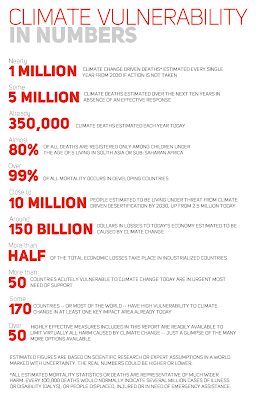
The disaster relief agency DARA provides a chart summarizing the need for prayers and action; especially telling is the heart-breaking report of who has been the most vulnerable to climate change in recent years.  

See 
http://daraint.org/climate-vulnerability-monitor/climate-vulnerability-monitor-2010/in-numbers/

According to this chart, as of 2010 there were already 350,000 deaths per year attributable to climate change. Of those deaths, nearly 80% were registered among one population: children under the age of 5 living in South Asia or Sub-Saharan Africa. Links next to the chart provide more statistics about where we have been and where we are expected to go in this century. From 2030 on, there are one million deaths per year expected, along with “several million cases” each year of illness or disability, or people displaced, injured, or in need of emergency assistance.

The prayers from SAFCEI  include a prayer for Rio+20 written by the Anglican Archbishop of Capetown, Thabo Makgoba.  The Rio+20 Conference is the UN Conference on Sustainable Development that will be held in Rio de Janeiro on June 20-22. The aim of the conference to find agreement on a range of measure that can reduce poverty while promoting decent jobs, clean energy, and a more sustainable and fair us of resources. (In the church, we might call this a stewardship conference.) The conference website says “Rio +20 is a chance to move away from business-as-usual and to act to end poverty, address environmental destruction and build a bridge to the future.”

The offering of many prayers for the world’s leaders to seek and find ways to end poverty and address environmental destruction is a good practice this month and every month!


Friday, April 20, 2012

Webcast: The Intersection of the Environment and Poverty


A forum about the intersection of the environment and poverty   – environmental justice – will be webcast tomorrow (April 21) at 11:00 central time. This forum was initiated by the Episcopal Church, and Presiding Bishop Katharine Jefferts Schori is the keynote speaker. Kim Lawton, senior editor and correspondent of the PBS program Religion and Ethics NewsWeekly is the moderator for the forum. St. Mark’s Cathedral in Salt Lake City is hosting the event.

After the forum, this webcast will be available for on-demand viewing for individuals or groups. There are two 45-minute panel discussions planned after the keynote address: Can Sustainability Initiatives Life those in Poverty? and Reducing Environmental Health Consequences for those in Poverty. Information about the panels and the connection to the webcast are available on this page on the Episcopal Church’s website. 

We tend to separate issues from one another, treating poverty and environmental issues and health issues as separate things. But everything is interconnected, and our understanding of all of these issues and our ability to serve others in the name of Christ are both increased by looking at the connections and intersections among various issues. In order to love our neighbors, we need to learn to care for the environment we all share.