Showing posts with label children. Show all posts

Sunday, March 23, 2014

Questions

Lent 3: The Woman at the Well

At Church of the Resurrection in Omaha today, Fr. Jason Emerson based this morning’s children’s sermon on the story of Jesus and the Samaritan woman at the well (John 4:5-42). After asking the children if anyone knew what a well was – “It’s like a big fish!” “No, that’s a whale. This was a well.” – Fr. Jason told them that in this story Jesus asks the woman at the well a lot of questions, but she also asks Jesus a lot of questions. He told the children that this was a good thing, and they should ask lots of questions, too.

I love watching the children interact with Fr. Jason and with one another, and when I can catch a little of the children’s sermon that takes place right before the beginning of the Sunday morning service, it gives me joy. But that joy was mixed with grave concern for these little ones this morning because of a question in something I had read about climate change before leaving for church, a new post on ClimateBites entitled Is it going to be bad or horrifically bad? That’s the scientific debate.

The post links to this video featuring an interview with climate scientist Justin Wood that encourages us to pay attention and become better educated about climate change:


Justin Wood: 97% of actual active climate scientists agree with that position that climate change is real, it's happening right now, and humans are the overwhelming cause in this century and have been for the last 100 years. 'Is it going to be bad or is it going to be horrifically bad' this is what the scientists debate around, not, you know, “it could be fine”. Nothing like that.

The way we are going, if we continue with business as usual if get these rises of temperature by the end of the century of 4, 6, 8, 10 degrees, then he (Professor Kevin Anderson, Professor of Energy and Climate at University of Manchester, United Kingdom) believes that we would be lucky if 5, maybe 10% of the human pollution survives the century. The planet would essentially be uninhabitable for humans.

Is it going to be bad or horrifically bad? Will human life by the end of this century simply be much more difficult or impossible?

Here is a question for all of us: What are we going to do about it? (As the video suggests, learning more about it is a good first step.)

A major question for the church in this century is: What is the church’s response to climate change? If our response is to ignore it because it seems difficult to talk about it or think about it, or because preachers are afraid of saying anything their congregations might find offensive on a Sunday morning, then we will have failed to be the Body of Christ to a hurting world.

In this morning’s Gospel, Jesus tells the Samaritan woman that the time is coming when “the true worshipers will worship the Father in spirit and in truth”. People who worship in truth are people who live in truth. If we are lying to ourselves to escape the hard truths of our world and to avoid the hardest moral issue of our time, how can we worship God in truth? If the church can’t find the moral courage rooted in faith to ask the hard questions, who can?

Questions are good. All of us, adults at least as much as children, need to ask lots of questions.

Nebraskans have a great opportunity to learn more about the intersection of faith, climate change, and environmental stewardship in general at a conference, Creation Care for Congregations, on April 26 at Nebraska Wesleyan University co-hosted by Nebraska Interfaith Power & Light and the Nebraska Energy Office. Rabbi Lawrence Troster will give the keynote address “All in the Same Boat: Confronting the Moral and Spiritual Challenge of Climate Change”.

The day’s schedule and more information is available at the Nebraska Interfaith Power and Light website.

Saturday, December 28, 2013

Holy Innocents

Today is the Feast of the Holy Innocents. Below is a reposted reflection on the day from last year. Children remain especially vulnerable to the impacts of pollution and climate change. The future of every child in the world is threatened by climate change, and we continue to place a low priority on addressing that threat. Last year's reflection ended with a video of the The Coventry Carol in honor of the innocents who died in Typhoon Sendong in the Philippines in 2011. This year I've shared another video of The Coventry Carol to honor the innocents who died this year in Typhoon Haiyan and in wildfires, floods, tornadoes and hurricanes and other extreme weather events this year.
***

We remember today, O God, the slaughter of the holy innocents of Bethlehem by King Herod. Receive, we pray, into the arms of your mercy all innocent victims; and by your great might frustrate the designs of evil tyrants and establish your rule of justice, love, and peace; through Jesus Christ our Lord, who lives and reigns with you in the unity of the Holy Spirit, one God, for ever and ever. Amen.  Collect for Holy Innocents, Book of Common Prayer, p. 238

Pollution and the effects of climate change impact children especially hard. Pollutants generally do more damage to developing bodies; dehydration from diarrheal diseases caused by lack of clean water is especially dangerous for infants and young children. According to World Health Organization information about climate change and health, “children – in particular, children living in poor countries – are among the most vulnerable to the resulting health risks” from climate change”. Among these risks are extreme heat, malnutrition, lack of clean water, impacts of natural disasters, and increasing risk of diseases such as malaria, dengue fever, and diarrheal diseases.

Today the church remembers the Holy Innocents, the children who died when Herod ordered the slaughter of all children who were two years old or younger (Matthew 2: 13-23). Augustine of Hippo called these children “buds, killed by the frost of persecution the moment they showed themselves.”

As air and water pollution and climate change take their toll of young lives, many children in our world never get a chance to be more than buds, buds killed in this case by the frost of the world’s indifference the moment they showed themselves.

The people with power in this world – the political leaders, the economically comfortable, the corporate heads – differ from Herod, of course. Their intention isn’t to cause the death of thousands of children; their intention instead is to maintain political power by not addressing a difficult problem, or to ignore the effects of climate change so that we can continue enjoying the sorts of comforts and conveniences to which we are accustomed, or to make a profit producing, selling, or investing in fossil fuels. Children are the collateral damage of our failure to control pollution and address climate change. There is no intention to harm, but instead of an intention to protect children, there is indifference and denial.

When we look the other way and refuse to acknowledge what is happening as a result of our failure to control pollution and address climate change, we aren’t really all that different from Herod. And the grief of the mothers of today’s innocent victims is no different from the grief of the mothers of Bethlehem some two thousand years ago.
***

Here is the Coventry Carol in honor of all the innocents killed by greed and indifference:


Saturday, December 7, 2013

Protecting our children and nature: fruit worthy of repentance

Advent 2

For the Second Week of Advent, two very different but related texts can help us be better prepared to celebrate the birth of Jesus and to receive Christ in our hearts at Christmas.

The first text is this week’s Gospel lesson from Matthew 3:1-12 about John the Baptist appearing in the wilderness and proclaiming, “Repent, for the kingdom of heaven has come near.”

The second text is a new report from eighteen of the world’s top climate scientists entitled Assessing ‘‘Dangerous Climate Change’’: Required Reduction of Carbon Emissions to Protect Young People, Future Generations and Nature. This report is well worth reading in its entirety, but there is also a summary  available. The summary explains that the paper “was initiated to provide the scientific basis for legal actions against national and state governments for not doing their job of protecting the rights of young people and future generations.” In doing so, it also helps lay the groundwork for a moral argument against our complacency as some of the wealthier people on the planet in the early part of the 21st century.

The paper argues that the 2° C warming that world climate forums have talked about as a limit that would prevent catastrophic climate change is too high a limit. (It should also be noted that several scientists think we are already on track to surpass that limit because of amplifying feedbacks.) This paper argues that 2° C warming creates instability that makes it impossible to stay at the two degree limit; two degrees of warming creates “slow feedbacks” that eventually lead to 3-4° C of warming. A simple example of feedback is the melting of the Arctic sea ice. Ice and snow reflect fairly large amounts of sunlight. When the ice melts, there is more open water and less ice, which means more sunlight is absorbed, which leads to more warming. This of course leads to further melting, which leads to further warming, and so forth. They argue that reducing global carbon emissions to 350 ppm by the end of the century can keep us within a warming limit that prevents catastrophe. And they note that “there is still opportunity for humanity to exercise free will”.

I love the beauty of our worship at Christmas, and I love the beauty and wonder of the Advent season that leads up to our great celebration of the Feast of the Incarnation. But my heart hurts when I realize how far from the mark of following Christ we can be when we focus more on the form and aesthetics of our worship than we do on our call to follow Christ. In this Sunday’s Gospel, John the Baptist says that it doesn’t matter if people are good religious folks – children of Abraham – if their lives don’t show it. “Bear fruit worthy of repentance” says John.

I hope that as we gather in churches on Christmas Eve that somewhere in a homily or in the prayers we name the reality and urgency of climate change. I hope that when we think about and speak about the Incarnation that we appreciate the depth of that mystery by looking at the reality of our world where God has chosen to come and dwell with us. I hope that as we prepare for the birth of the Holy Child and then celebrate the birth, and as we prepare to enjoy and delight the children we know and love, that we care enough about both the Christ-child and our own children to bear fruit worthy of repentance and work as hard as we can to stop the burning of fossil fuels and be willing to change the way we do things so that future generations might live.


Friday, December 28, 2012

Holy Innocents


We remember today, O God, the slaughter of the holy innocents of Bethlehem by King Herod. Receive, we pray, into the arms of your mercy all innocent victims; and by your great might frustrate the designs of evil tyrants and establish your rule of justice, love, and peace; through Jesus Christ our Lord, who lives and reigns with you in the unity of the Holy Spirit, one God, for ever and ever. Amen.  Collect for Holy Innocents, Book of Common Prayer, p. 238

Pollution and the effects of climate change impact children especially hard. Pollutants generally do more damage to developing bodies; dehydration from diarrheal diseases caused by lack of clean water is especially dangerous for infants and young children. According to World Health Organization information about climate change and health, “children – in particular, children living in poor countries – are among the most vulnerable to the resulting health risks” from climate change”. Among these risks are extreme heat, malnutrition, lack of clean water, impacts of natural disasters, and increasing risk of diseases such as malaria, dengue fever, and diarrheal diseases.

Today the church remembers the Holy Innocents, the children who died when Herod ordered the slaughter of all children who were two years old or younger (Matthew 2: 13-23). Augustine of Hippo called these children “buds, killed by the frost of persecution the moment they showed themselves.”

As air and water pollution and climate change take their toll of young lives, many children in our world never get a chance to be more than buds, buds killed in this case by the frost of the world’s indifference the moment they showed themselves.

The people with power in this world – the political leaders, the economically comfortable, the corporate heads – differ from Herod, of course. Their intention isn’t to cause the death of thousands of children; their intention instead is to maintain political power by not addressing a difficult problem, or to ignore the effects of climate change so that we can continue enjoying the sorts of comforts and conveniences to which we are accustomed, or to make a profit producing, selling, or investing in fossil fuels. Children are the collateral damage of our failure to control pollution and address climate change. There is no intention to harm, but instead of an intention to protect children, there is indifference and denial.

When we look the other way and refuse to acknowledge what is happening as a result of our failure to control pollution and address climate change, we aren’t really all that different from Herod. And the grief of the mothers of today’s innocent victims is no different from the grief of the mothers of Bethlehem some two thousand years ago.

Here is the Coventry Carol in honor of the innocents who died in Typhoon Sendong in the Philippines in 2011.


Tuesday, June 5, 2012

Prayers for World Environment Day


Seeking an End to Poverty and Environmental Destruction

In observance of World Environment Day, Mike Schut (Economic and Environmental Affairs Officer of the Episcopal Church) and the Episcopal Ecological Network have sent on a link to prayers for World Environment Day 2012  from the Southern African Faith Communities’Environment Institute (SAFCEI).  The prayers include petitions for social and economic justice, concerns that are intertwined with our concern for the environment; for peace through justice; for better governance and leaders who follow “spiritual and ethical guidelines”.

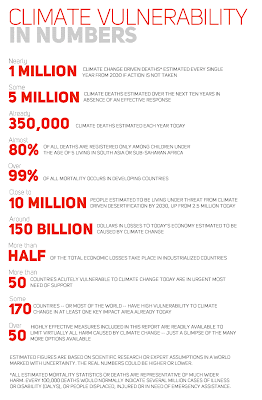
The disaster relief agency DARA provides a chart summarizing the need for prayers and action; especially telling is the heart-breaking report of who has been the most vulnerable to climate change in recent years.  

See 
http://daraint.org/climate-vulnerability-monitor/climate-vulnerability-monitor-2010/in-numbers/

According to this chart, as of 2010 there were already 350,000 deaths per year attributable to climate change. Of those deaths, nearly 80% were registered among one population: children under the age of 5 living in South Asia or Sub-Saharan Africa. Links next to the chart provide more statistics about where we have been and where we are expected to go in this century. From 2030 on, there are one million deaths per year expected, along with “several million cases” each year of illness or disability, or people displaced, injured, or in need of emergency assistance.

The prayers from SAFCEI  include a prayer for Rio+20 written by the Anglican Archbishop of Capetown, Thabo Makgoba.  The Rio+20 Conference is the UN Conference on Sustainable Development that will be held in Rio de Janeiro on June 20-22. The aim of the conference to find agreement on a range of measure that can reduce poverty while promoting decent jobs, clean energy, and a more sustainable and fair us of resources. (In the church, we might call this a stewardship conference.) The conference website says “Rio +20 is a chance to move away from business-as-usual and to act to end poverty, address environmental destruction and build a bridge to the future.”

The offering of many prayers for the world’s leaders to seek and find ways to end poverty and address environmental destruction is a good practice this month and every month!


Wednesday, December 28, 2011

Holy Innocents: The Most Vulnerable


Today the church remembers the Holy Innocents, the children who died when Herod ordered the slaughter of all children who were two years old or younger (Matthew 2: 13-23)  .  According to Lesser Feasts and Fasts, Augustine of Hippo called these children “buds, killed by the frost of persecution the moment they showed themselves.”

As climate change takes its toll with extreme weather, flooding, famine, and the spread of tropical diseases, many children in our world have their lives cut very short, buds killed in this case by the frost of the world’s indifference the moment they showed themselves. MediaGlobal reports that children are the people most vulnerable to the effects of climate change, citing a recent Climate Vulnerability Monitor report that says that 99 per cent of climate change deaths occur in developing countries, and that of those deaths, over 80 per cent are children. Children are especially vulnerable to climate change because they are more vulnerable to malnutrition, cholera, diarrheal disease, dengue, and malaria.

Last summer, Josette Sheeran, executive director of the UN World Food Program, said that the famine in East Africa was “the children’s famine” because “the ones who are the weakest are the children and those are the ones we're seeing are the least likely to make it.” This famine was caused by a severe drought and exacerbated by the political situation.   The U.S. estimated at the beginning of Augustof this year that 29,000 Somali children under the age of five had died in the past three months; at the same time the U.N. said that 640,000 Somali children were “acutely malnourished”.

The people with power in this world – the political leaders, the economically comfortable, the corporate heads – differ from Herod, of course. No one intends to cause the death of thousands of children; the objective is to maintain political power by not addressing a difficult problem, or to ignore the effects of climate change so that we can continue enjoying the sorts of comforts and conveniences to which we are accustomed, or to make a huge profit producing and selling carbon intensive energy resources or something dependent on them. Children are the collateral damage of our failure to address climate change, just as children are so often the collateral damage of wars.

But even Herod himself didn’t care one way or the other about the children who were slaughtered. His objective was to eliminate one child; the others were collateral damage to his cause. When we look the other way and refuse to acknowledge what is happening as a result of our failure to address climate change, we aren’t really all that different from Herod. And the grief of the mothers of today’s innocent victims is no different from the grief of the mothers of Bethlehem or the grief of Rachel.


Thursday, November 17, 2011

Seeing and Serving Christ


Proper 29A

Almighty and everlasting God, whose will it is to restore all things in your well-beloved Son, the King of kings and Lord of lords: Mercifully grant that the peoples of the earth, divided and enslaved by sin, may be freed and brought together under his most gracious rule; who lives and reigns with you and the Holy Spirit, one God, now and for ever. Amen.
Proper 29 Collect, The Book of Common Prayer, p. 236

This last Sunday of the lectionary year focuses on Christ as King of kings and on God’s restoration of all things through Christ.  The Gospel text, Matthew 25:31-46, first identifies Christ with a king sitting on “the throne of his glory”. As Jesus describes what the king will do, however, we find Christ also identified with the people in greatest need who are most likely to be ignored, the opposite of a king seated in glory: “Just as you did it to one of the least of these who are members of my family, you did it to me.”

The meaning of this is plain: When we see people in need and do what we can to meet their needs, we see and serve Christ. When we fail to see those in need, or see them and ignore their needs, we fail to see and serve Christ.

We know that in today’s global community, despite our access to information from all over the world, those most affected by pollution and climate change are often ignored and virtually unseen by people in other places.

Because of concern about our own water and land, Nebraskans now know about the Alberta tar sands. What many of us do not know, however, are the effects of the pollution from the mining of the tar sands on people living downstream from it. This magazine recently published a photo essay about the community of Fort Chipewyan and how the health and culture of the people there have been affected by tar sands mining.

UNICEF released a report on Monday called Children and Climate Change: Children’sVulnerabilities to Climate Change and Disaster Impacts in East Asia and the Pacific. The report describes ways in which children, because of their developing bodies and immune systems and their place in society, are particularly vulnerable to the impacts of climate change. It describes the direct impacts from storms and higher temperatures; the increase in diseases such as cholera, diarrheal disease, dengue, and malaria; and psychological, educational, and nutritional impacts of climate change. Here also, the situations described are nearly unknown and/or ignored by people in our part of the world, but the report stresses that they are very real to the children in that part of the world.

These are only two examples of situations in which we fail to see those in need or see them and ignore their needs, thus failing to see and serve Christ. Our Sunday lessons remind us that Christ is King of kings but is also identified with the poorest of the poor. To forget either – that Christ is the ultimate authority or that Christ is found among those people we easily ignore – leads us to all sorts of moral and theological error and weakens the church’s ability to serve God’s children.

This Sunday's passage from Paul’s letter to the Ephesians (Ephesians 1:15-23) says that the church is the body of Christ. If the church serves as the body of Christ, we must be about the work of reconciliation and restoration, which dovetails with the work of seeing and serving those in need.  Working towards the restoration of all things in creation, including eliminating pollution and curbing global warming, would do a lot towards making clean water, ample and healthy food, and healing available to all of God’s children. If we are the authentic church, the body of Christ, we will be about this work, seeing and serving the poorest of the poor in the name of the King of kings.


Thursday, February 10, 2011

More For the Children

(In which we adult camels approach the eye of the needle)


Back in October, 2009, I posted a piece called Hackberry Tree Parable about today’s Daily Office reading from Mark (Mark 10:17-31), which was the Gospel lesson for the coming Sunday lectionary. This was a story about some sort of big bird of prey crashing down through the branches of our hackberry tree holding onto a struggling squirrel. Finally, by letting go of the squirrel, the bird was able to right itself and soar away. Seeing that little drama while thinking about the rich man who went away grieving when Jesus told him the way to inherit eternal life was for him to sell everything he had, give the money to the poor, and follow Jesus, I wrote this:

Birds of prey most often succeed in hunting the weakest animals, the most vulnerable. The squirrel this one chose wasn’t as weak as it appeared evidently, and gave the bird a great deal of trouble. What’s interesting in light of the Gospel story is that it wasn’t just in letting go of something that the bird was able to fly freely again, but in letting go of the smaller, weaker creature on which it was preying. This little drama as it relates to the Gospel lesson wasn’t only about the raptor and its need to let go of a difficult weight, but about the squirrel and its desire to survive. The Gospel story isn’t only about us and our need to be detached from things that get in the way of discipleship; it’s also about those who have less power, wealth, and strength but about whom Christ cares very much. We aren’t truly free of the things that weigh us down until we join Christ in caring for and about the poor and vulnerable. It isn’t enough to go off and take a vow of poverty and simplify our lives; true discipleship involves noticing and caring for people who have to worry more about not having enough than about having too much.

Yesterday’s Gospel reading, the passage immediately before this in Mark, was about Jesus blessing the children. No matter where they live, young children are among the vulnerable because of their lack of power. Given the facts about global warming and climate change, we know we need to let go of some of our habits and comforts to make any sort of decent life for the children being born today.

I’ve often wondered about the man in today’s Gospel lesson. What happened after he recovered from the shock of what Jesus had said to him; what did he do after he went away grieving? Did he continue to live as he had, knowing at least somewhere in the back of his mind that he wasn’t living the way God called him to live, or did he indeed sell his possessions, give the money to the poor, and go follow Jesus?


And, not so much out of curiosity as out of existential angst, I wonder about us. What do we do after the shock of realizing what science tells us about the future of our planet if we don’t dramatically and immediately cut back on our emissions of greenhouse gases? What do we do after grieving for the world we have known and asking God to forgive us for what we have done to God’s creation? Does our generation continue living as we have, vaguely knowing we aren’t doing what God would have us do, but unwilling or unable to let go of our privilege and comfort so that today’s children and their children might live? Or do we change our habits and public policies, gladly letting go of some of those privileges and comforts so that we can follow the example of Jesus and recognize that the decisions we make now are having an impact on children, those vulnerable ones who don’t get to make the decisions that are determining their future?

Tuesday, February 8, 2011

For the Children

The Daily Office Gospel reading for Wednesday (Mark 10:1-16) includes the story of Jesus blessing the children. Jesus made it plain that even if the children didn’t have much importance to others, they were important to him. By his example of not allowing the disciples to keep the children at arm’s length from him, Jesus teaches us the importance of seeing children as individuals in need of love and protection, not as abstractions.

I’ve just begun reading a new book by Mark Hertsgaard, Hot: Living Through the Next Fifty Years on Earth. While many books have been written about dealing with climate change, this one has a depth to it that is helpful to those of us looking at the environment through a spiritual lens. I’ve been thinking the past year about our culture’s denial of the realities of climate change and our seeming inability to begin looking at what is happening and how we might best deal with it. This book articulates very well some of the issues involved in all of this.

Hot brings home the reality of our warming climate through a father’s passion for his own daughter’s future. Mark Hertsgaard had reported on the plight of children in other countries before his own daughter’s birth, but realized after she was born that he had been able to keep an emotional distance from the stories of these children that parents don’t have.

Reviewing Hot in the New York Times, Wen Stephenson writes that this book “raises the emotional stakes while keeping a clear head.” Stephenson then says: “This was the first book on climate change that not only frightened me — plenty have done that — but also broke my heart.” Perhaps our hearts need to be broken before we can bring ourselves out of denial and get to the place where we can help one another cope with this changing world.

In the Prologue to the book (which is available here through Google books), Mark Hertsgaard talks about the moment when his view of the world changed, when the issues of climate change became so real to him that he knew he had to find out all he could and work on figuring out how people can live through the period of climate change we have now entered. The shift came in 2005 when Hertsgaard was a new father of a baby girl. He interviewed David King, a prominent British climate scientist, who talked about climate change not as something in the future that we might possibly yet avoid, but as something that had already begun unfolding. Even if our greenhouse gas emissions were cut drastically and immediately, there would still be global warming for many years as a result of the processes that had already begun. After the interview, Hertsgaard realized that the time period they had been discussing was his daughter’s lifetime, that this warmer, more difficult world was the world in which his little girl would grow up and live her life.

Hot not only takes a realistic look at where we are now, but looks with hope at things we can do – and that some people and governments are already doing – to make the best of the future. Hot: Living Through the Next Fifty Years on Earth is not a religious environmental book, but its compassion for our children and its elements of hope speak to people of faith.