Showing posts with label Arctic sea ice. Show all posts

Monday, February 19, 2018

Wilderness


A week ago, those of us who observe Ash Wednesday and want to encourage others to practice those things that give us a holy beginning to Lent were wondering how much of a shadow Valentine’s Day would cast over the beginning of Lent in the greater culture. What would people be thinking about Wednesday evening — hearts and flowers, or the beginning of our forty day wilderness journey? By evening, though, the nation’s focus was on yet another in a series of horrible acts of violence, this one a school shooting in Parkland, Florida that killed seventeen people. Once again, American children were killed at school. Once again, our nation’s leaders were big on thoughts and prayers but not so interested in talking about what substantial policy changes they proposed to help protect our children from deadly violence at school. 
We are in the wilderness, and not just the figurative wilderness of our Lenten journey. We are lost in a place that is empty and disorienting and frightening. Taken as a group, the adults of our nation have forsaken our responsibilities to our children. We have said we love our nation’s children even as we allow greed and sloth and probably several other deadly sins to keep us from having policies such as those in other nations that would make our public places, including our schools, much safer places for children. 

That we Americans allow sin to keep us from protecting our children is no new revelation, of course. We have been in the wilderness a long time, watching global temperatures rise along with concentrations of greenhouse gases in our atmosphere while greed and sloth and probably several other deadly sins keep our leaders from developing policies that could mitigate the effects of climate change. 

Much has been made of the hollowness of “thoughts and prayers” without action after events like mass shootings. Prayers of confession and repentance, though, necessarily result in action. Truly changed hearts result in truly changed lives. Truly changed hearts in our nation’s adults would produce genuine love that would not let sin get in the way of protecting our children. That said, we as a culture are far from that point of conversion. So long as a short-sighted desire for a perceived private gain trumps any impulse toward the public good in the hearts of voters and the people they choose to develop our public policies, we will remain in the wilderness. 

At its best, the wilderness is a place where so much is stripped away that we see ourselves as we are — our sins along with the gift of being beloved children of God — and repent. This is why many Christians choose some sort of discipline for Lent that echoes the wilderness experience; that wilderness experience can bring us closer to God when it results in penitent hearts. When we see clearly who we are and the things that tempt us and then choose to turn our backs on the temptations, we are ready to leave the wilderness. 

But some of us won’t even acknowledge that we are in the wilderness.  If we refuse to acknowledge the reality of our situation, if we pretend that we can continue living as we do and putting our sinful desires before our love of God and our neighbors — including our children — we will remain stuck in the wilderness, lost in a place that is empty and disorienting and, if only we would let ourselves feel it, frightening.

This week, much of our nation was shaken by yet another school shooting. This week also the Bering Sea lost a shocking amount of sea ice, something that should not be happening at all in February. The upshot of these big changes in the Arctic region is that changes in the Arctic create changes in weather patterns further south that promise to be very disruptive. An unstable Arctic means an unstable planet, and an unstable planet means a terrible legacy for our children and grandchildren. 

We are in the wilderness. Some of us want to do what we must to get out of the wilderness, and some of us don’t care enough about ourselves or others to even tell ourselves the truth about where we are. Our work is to do our own work of repentance, and then take the news — both the news of the reality of our situation on earth and the good news of repentance and restoration — to others. 

For everyone this year, not just observant Christians, Ash Wednesday revealed just how far astray we have gone. Jesus calls us back to the discipline of love that will make all the difference in how we live. 


Friday, December 27, 2013

Joy: Day 3

Joy to the world! The Lord is come: let earth receive her king;
Let every heart prepare him room, and heaven and nature sing.

With “Joy to the world” in our hearts and minds, I invite you to join me in looking each of these twelve days for instances of the joy that runs through all of creation, especially through experiencing the beauty and wonder of God’s world.


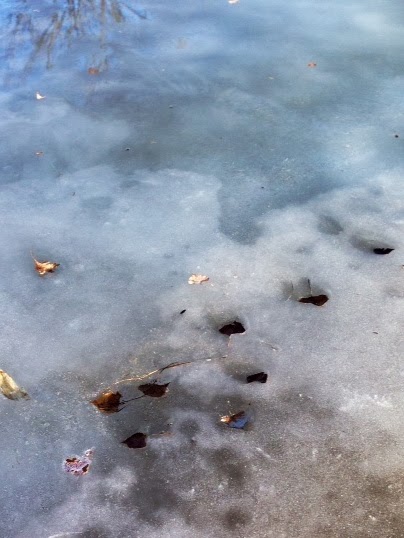
Temperatures above 50 degrees today in our part of Nebraska along with a good dose of midday sun helped it feel very comfortable outside despite a fairly good breeze. In the afternoon, we walked at a lake where whatever ice had formed earlier was melting. Leaves that had been caught in the top of the ice when it had frozen had absorbed enough heat from the sun to begin melting the ice around each leaf.

It’s such an elegantly simple example of something all of us who have lived with ice and snow know, that darker surfaces absorb heat from the sun and speed the thawing of ice and snow around them. This is why the melting of Arctic ice has produced a feedback loop that has accelerated the melting: as ice melts, open water is exposed. The open water absorbs heat from the sun that would be reflected by ice. As more heat is absorbed, the melting of the ice is accelerated.

There’s some joy in knowing that we understand a lot about the science of climate change. Should the powers that be ever decide to do something significant to mitigate climate change, scientists can help to maximize that effort. But the beauty of each little depression slowly growing as the sun shone was the surest and most immediate joy, wonder enough for today.


Joy to the world! The Savior reigns; let us our songs employ, while fields and floods, rocks, hills, and plains, repeat the sounding joy.

Sunday, December 15, 2013

Advent 3: Visions of Hope

The wilderness and the dry land shall be glad, the desert shall rejoice and blossom; like the crocus it shall blossom abundantly, and rejoice with joy and singing. The glory of Lebanon shall be given to it, the majesty of Carmel and Sharon. They shall see the glory of the Lord, the majesty of our God. Strengthen the weak hands, and make firm the feeble knees. Say to those who are of a fearful heart, “Be strong, do not fear! Here is your God. He will come with vengeance, with terrible recompense. He will come and save you.” (Isaiah 35:1-4)

Jesus answered them, “Go and tell John what you hear and see: the blind receive their sight, the lame walk, the lepers are cleansed, the deaf hear, the dead are raised, and the poor have good news brought to them. (Matthew 11:4-5)

Each week seems to bring new information about climate change, its effects, and the pace at which those effects are unfolding. How hopeless is it?

This week’s climate news included a report of a research project by a US Navy scientist that predicts an ice-free Arctic Sea by fall of 2016 (plus or minus three years -- which means sometime between now and 2019). How hopeless is it?

We know we have passed the point where lowering our emissions of greenhouse gases can prevent global warming. The warming that has already taken place has set feedback loops in motion that will cause some level of warming to continue even if we suddenly do the politically improbable and manage to lower the level of greenhouse gas emissions by a significant amount. The aim now is mitigation: lessening global warming and its effects as much as possible given the physical and chemical reality of our situation. 

Sign on the way to church last Sunday
Our lesson from Isaiah (Isaiah 35:1-10) for the Third Sunday in Advent describes a beautiful time when all of nature is full of joy, when flowers bloom in the desert and God’s unmistakable presence fills the world. It describes not a picture of what is but a vision of God’s possibilities. The prophetic visions of Scripture came to men and women well aware of the realities of their times and places. There are words of warning as well as words of promise. The visions were not a denial of reality; instead, they were rooted in that reality, a reality that the prophets saw more clearly than those around them. The prophetic visions provided a dream of new possibilities and an ideal by which to measure the present reality. The prophetic visions were an opening up of a new reality that could begin to unfold if people radically changed their way of life and returned to true worship that would remove the internal and external barriers to the unfolding of the vision.

While visions of hope are hard to find in climate science reports that document an accelerating warming and predict catastrophic results if we remain on our current path of greenhouse gas emissions, there are signs of change. In Jesus’ time and place, there was plenty of sickness, poverty, and oppression even though Jesus was healing. John the Baptist asks whether Jesus is the one they've been waiting for or if there is another. Jesus says (Matthew 11:4), “Go and tell John what you hear and see”, and lists signs of hope. We can look at signs of something changing – e.g. several coal-fired power plants shut down various places including Massachusetts and Chicago, solar energy use on the increase worldwide, decreasing use of automobiles in younger Americans, the wind- and solar-powered barn built in the path of the Keystone XL pipeline here in Nebraska. These things alone aren't enough to prevent catastrophic warming, but they may be signs of bigger changes that are coming to be.

This Third Sunday of Advent there is hope. We don’t know what shape hope takes in our generation. Authentic hope is not naïve; hope doesn't say everything will be fine, and it certainly doesn't say that everything will be just the way it was before humankind spewed enough greenhouse gases into the atmosphere to warm the planet to the point where feedback loops accelerate the warming.

Our hope means that we know that God is with us and God is faithful. It means that there is a bigger picture we simply cannot see from our little corner of the universe and our tiny point in history. It means that there are visions of what might be that we might be able to see if we turn away from our accustomed way of living and open ourselves to something new. As we are reminded especially during Advent, hope means God is with us no matter what.


Saturday, February 16, 2013

Praying the News


February 16, 2013

In our prayers, we thank God for the wonders of creation, pray for those parts of creation that need repair and healing because of our carelessness, and ask for the wisdom, will, and courage to preserve and protect the biosphere that makes human life both possible and rich.

Almighty God, in giving us dominion over things on earth you made us fellow workers in your creation: Give us wisdom and reverence so to use the resources of nature, that no one may suffer from our abuse of them, and that generations yet to come may continue to praise you for your bounty; through Jesus Christ our Lord. Amen.
Collect For the Conservation of Natural Resources (The Book of Common Prayer, p. 827)

Please pray for:

Relief from the ongoing drought on the Great Plains.  This week’s US Drought Monitor report shows some improvement in this part of the country, but as their map shows, most of Nebraska remains in extreme or exceptional drought conditions. Coupling prayers for seasonable weather with prayers of repentance for our part in creating the greater issue of climate change might help us find our way forward.

The Arctic sea ice and eyes to see and minds to understand the significance of the loss of ice. The UK’s Natural Environmental Research Council (NERC) has confirmed earlier estimates of a collapse of the sea ice in the Arctic. Total sea ice volume in the Arctic is one-fifth what it was in 1980. Analyst Andy Lee Robinson has put the data in graphic form that shows the spiraling collapse of the sea ice:

From http://haveland.com/share/arctic-death-spiral-1979-201301.png


 People in Washington, DC, for Sunday’s Forward on Climate rally. Thousands of people are expected to rally in Washington tomorrow to ask President Obama to lead on addressing climate change, beginning with denying a permit to complete the proposed Keystone XL pipeline. Several Nebraskans will be part of this, carrying with them our concerns about the this pipeline that would cross Nebraska. Pray for protection as they travel and rally, for peaceful hearts and effective voices, and for wise leadership from our President and other leaders; and offer prayers of thanksgiving for these people willing to speak with their voices and their presence at this gathering.

O God, you have bound us together in a common life. Help us, in the midst of our struggles for justice and truth, to confront one another without hatred or bitterness, and to work together with mutual forbearance and respect; through Jesus Christ our Lord. Amen.
Prayer In Times of Conflict (The Book of Common Prayer, p. 824)

O God, our heavenly Father, you have blessed us and given us dominion over all the earth: Increase our reverence before the mystery of life; and give us new insight into your purposes for the human race, and new wisdom and determination in making provision for its future in accordance with your will; through Jesus Christ our Lord. Amen.
Prayer For the Future of the Human Race (The Book of Common Prayer, p. 828)

As we pray for others, we might also pray for our own hearts to be open so we can see the needs in the world around us and gladly respond to those needs:

O heavenly Father, who has filled the world with beauty; Open our eyes to behold your gracious hand in all your works; that, rejoicing in your whole creation, we may learn to serve you with gladness; for the sake of him through whom all things were made, your Son Jesus Christ our Lord. Amen.
Prayer for Joy in God’s Creation (The Book of Common Prayer, p. 814)


Saturday, September 15, 2012

"Wisdom cries out in the street..."


Proper 19B. Proverbs 1:20-33

A sampling of this week’s stories about our changing climate and its effects include these about this year’s record number of extreme weather events:

·                     Andrew Freedman reported 2012 Has Had Most Extreme Weather on Record for U.S.  on Climate Central.
 
          Kelly Levin posted Timeline: Extreme Weather Events in 2012 on the World Resources Institute’s WRI Insights website.  Along with giving a useful visual representation of some of this year’s extreme weather events around the world, the timeline includes the dates of some of the scientific reports connecting extreme weather events and climate change.

There were several stories this week about the astonishing Arctic sea ice melt this summer. A few of them are:

·                     A report from Nature entitled Ice loss shifts Arctic cycles  that looks at the effects of these changes in the Arctic on ocean circulation, ecological systems, and atmospheric pressure, all of which entail global effects.
 
         Climate Central posted ‘Astonishing’ Ice Melt May Lead to More Extreme Winters  which discusses how this record loss of ice could affect winter weather in Europe and North America this year. An increase in extreme weather events is expected with changes in the jet stream.
 
         A post from John Vidal aboard the Greenpeace ship Arctic Sunrise suggests that the reported record ice melt may in fact be underestimating the amount of the melt. The Arctic Sunrise was traveling through an area that the data indicated was still covered with ice, but is actually about 50% melted.
 
Shifting from the Arctic to the warm waters of the Caribbean, this week brought a report that coral reefs in the Caribbean are “on the brink” of collapse from warming waters and increasing ocean acidity. When coral reefs collapse, entire marine eco-systems collapse.

Our Sunday lesson from Proverbs (Proverbs1:20-33) is in the voice of Wisdom warning as a prophet warns that scoffing at wisdom results in disaster. Given the warnings we tend to push aside and ignore, these words from Wisdom might get our attention:  “I also will laugh at your calamity…when panic strikes you like a storm, and your calamity comes like a whirlwind, when distress and anguish come upon you.”

Given what is happening to the Arctic, to the oceans, to the stability of our climate, our complacency seems irrational. At the end of this passage from Proverbs, Wisdom says that “the complacency of fools destroys them”. However, “those who listen to me will be secure and will live at ease, without dread of disaster”.

Nearly every week now brings news about further evidence of climate change and its dire effects on ecosystems and the welfare of living things. This week’s passage from Proverbs might help bring us out of our complacency so we can make wiser choices and mitigate the effects of climate change. It also helps us on a deeper level. Perhaps those who listen to wisdom live without dread of disaster not because they will avoid disaster, but because their wisdom allows them to face disaster with inner peace.

It suggests that our response as Christians to climate change is both to do what we can to avoid complacency and advocate for a reasoned response to climate change, and also – no matter what choices humanity as whole makes in response to climate change -- to be wise ourselves, grounded in faith and hope, secure in Christ’s peace.


Friday, August 31, 2012

Children, Melting Ice, Fires, and More


August

Platte R. near Grand Island 8/9/2012
At St. Stephen’s in Grand Island, August began with a one-day Vacation Bible School with the theme “Recycling God’s Love”. With Psalm 24:1 – “The earth is the Lord’s and all that is in it, the world and all who dwell therein” -- as our organizing Bible verse, we talked about the responsibility we have as God’s children to care for the earth and all the gifts God has given us. Our music director, Dan Korensky, wrote an energetic song for us based on the verse. Dan’s help was enlisted by his wife, Brittany Korensky, who took charge of VBS this year with help from other Christian education volunteers and the parish Green Team.

We talked about what happens to things we throw "away" and what happens to things we recycle, and we did “audit” of the waste from St. Stephen’s church and community center, separating out the recyclables that had found their way into the trash.


Gathering in small groups, the children wrote or drew the things in creation for which they are thankful. We gathered these together in a paper “quilt”, and Fr. Peek gathered their responses into a psalm to use in worship Sunday morning.


After lunch and games, the children used paper from discarded magazines and newspapers to make two collages. The results were stunning!


It was a good way to start a month that brought news of Hurricane Isaac, record temperatures, floods, melting Arctic sea ice, and more, and that is ending here in Nebraska with fires in the western part of the state. (See more information about the fires from the Lincoln Journal Star and KQSK radio  in Chadron.)

On August 20, the American Meteorological Association released an information statement about climate change. The concluding portion of the statement says:

There is unequivocal evidence that Earth’s lower atmosphere, ocean, and land surface are warming; sea level is rising; and snow cover, mountain glaciers, and Arctic sea ice are shrinking. The dominant cause of the warming since the 1950s is human activities… Prudence dictates extreme care in accounting for our relationship with the only planet known to be capable of sustaining human life.

On August 26 the extent of the Arctic sea ice fell below the record for minimum ice cover that was set in 2007. (See this from the NASA Earth Observatory.) Along with giving clear evidence of warming, affecting life for plants, animals, and humans in the Arctic, and opening more open water to absorb sunlight and accelerate the warming cycle, there are effects on the stability of the climate for the entire planet that are of grave concern. (See Why the Arctic Sea Ice Death Spiral Matters  by Joe Romm.)

Some parishes do a blessing of the backpacks (and of the children who carry them) at the beginning of the school year. We send children off to school hoping that they will learn and grow physically, intellectually, and spiritually, hoping they will grow to have meaningful and productive lives. We assume that they will experience many of the pleasures as adults as we do in Nebraska today: comfortable homes, access to clean water and adequate food, stable governments and institutions. So much of what we hope for our children depends on a stable climate!

Jesus taught us that children are important. Jesus loved the children, and we say we do, too. Talking about climate change, learning all we can about it, and making it an important issue in our common life is a way to truly love the children in our lives and around the world.


Monday, November 21, 2011

Praying the News: November 21 2001


Praying the News offers a way of lifting up people and situations to God and inviting others to do the same. We listen as well as speak in prayer, sometimes gaining wisdom or insight in difficult 
situations.


Almighty God, in giving us dominion over things on earth you made us fellow workers in your creation: Give us wisdom and reverence so to use the resources of nature, that no one may suffer from our abuse of them, and that generations yet to come may continue to praise you for your bounty; through Jesus Christ our Lord. Amen.
Collect For the Conservation of Natural Resources (The Book of Common Prayer, p. 827)

Please pray for:

Coastal cities planning for the 2020’s and beyond.  A report commissioned by the state of New York’s energy research agency was released this week. (See this Associated Press story.) The report, written by fifty scientists, describes expected changes in climate and their expected effects on New York state so that New York can be prepared to minimize negative impacts and maximize positive impacts. With sea level rising up to ten inches by the mid-2020’s around Long Island and Manhattan, storm surges could flood airports, subway tunnels, and the financial district. New York and other coastal cities need wisdom and courage to look ahead and plan for rising sea levels

Fort Chipewyan in Alberta and all communities around the world that suffer health and social stresses from mining.  Last Thursday’s post Seeing and Serving Christ mentioned how the health and culture of the people of Fort Chipewyan have been affected by pollution from tar sands mining. That post referenced this soberingphoto essay  from This magazine. People in communities near large-scale mining operations suffering ill-effects from pollution is not unique to this situation, of course. Appalachian communities in areas where mountaintop removal is practiced, for example, are subject to negative impacts to their health and safety .  

The rapidly warming Arctic region. While the IPCC predicts that Arctic Sea ice will completely melt in summers sometime in the 2030’s, a study by Prof. Peter Wadhams of Cambridge University says that the ice could be gone as soon as 2015 – four years from now. Whichever estimate is correct, the ice is melting rapidly, with huge consequences for the Arctic ecosystem with such drastic changes in habitat. This includes consequences for people living in the Arctic region.

Participants in the COP-17 climate summit in Durban.  A call has gone out for Anglicans to pray for the 17th Congress of the Parties (COP-17) to the United Nations Framework Convention on Climate Change as they meet in Durban, South Africa, beginning next week. Episcopal News Service reports:
Despite 17 years of negotiations to cut warming emissions, current global pledges to cut emissions leave Earth on track for between 2.5 and 4 degrees of warming, widely agreed to be catastrophic," the Rev. Canon Rachel Mash, environmental coordinator of the Anglican Church of Southern Africa and member of the Anglican Communion Environmental Network, said in an Anglican Communion News Service release.
As we pray for others, we might also pray for our own hearts to be open so we can see the needs in the world around us and gladly respond to those needs:

O heavenly Father, who has filled the world with beauty; Open our eyes to behold your gracious hand in all your works; that, rejoicing in your whole creation, we may learn to serve you with gladness; for the sake of him through whom all things were made, your Son Jesus Christ our Lord. Amen.
Prayer for Joy in God’s Creation (The Book of Common Prayer, p. 814)


Sunday, July 17, 2011

Hope and the Work at Hand

Proper 11A

Today’s lectionary readings include the passage from Romans (Romans 8:12-25) in which Paul talks about hope and how the whole of creation is waiting to be set free from its bondage to decay. One of last July’s posts, Hope,talked about this passage in light of two very different experiences: the peaceful experience of sitting outside on a summer morning for prayer, study, and contemplation, and the experience of feeling helpless and discouraged hearing news about pollution and climate change.

More recently, a post about Innate Optimism, Bad News, and Hope from the end of May talked about this passage in relation to even more discouraging news about the climate than we had a year ago. That post asked a couple of questions and offered a couple of general ideas about the particular contributions Christians might make as we face the realities of climate change:

One of the questions the church might be asking is what form our hope should take: What are our specific hopes in relationship to the realities of climate change? That we won’t face hardship? That our leaders will get it together at the last possible moment to avert the worst of the disasters that await us if we continue doing little or nothing? That we will simply find a way to live with dignity and meaning in the midst of all of this?

Other institutions are or will be working on other aspects -- economic, engineering, agricultural, military, political, etc. -- of adaptation to a warming world. Along with our traditional roles of disaster relief, perhaps the church should be thinking and praying about the deeper adaptation, the spiritual adaptation, to a world of increasing challenges and hardships. Christian love, our values of charity and kindness and care for our neighbors, will be an essential part of humankind’s adaptation to these new challenges. The sort of deep resilience that is rooted in faith is something else that might allow us to face our future with dignity and real hope.

This morning’s Gospel lesson (Matthew 13:24-30, 36-43) can give us some more insight into what our work might be at this time. The parable of the wheat and the weeds (formerly known as tares) makes it clear that it’s not our job to figure out who’s in and who’s out in God’s kingdom. Even if we could discern the wheat from the weeds, the web of interconnections that make up humankind and all of creation make it impossible to exclude others without ultimately excluding ourselves. But there is plenty of work for us to do; Jesus is clear about what our work is: the greatest commandment is the commandment to love. That love takes the form of serving one another: healing the sick, feeding the hungry, doing whatever we can to tend to “the least of these, the people in our world who are easily ignored or overlooked, the people who might look like weeds to us but might very well look like saints to God. The Gospel tells us that when our brothers and sisters are suffering because of environmental degradation, love calls us to do something to lessen that suffering and bring healing where there is brokenness.

Paul’s passage about hope seems to spring up in the Sunday lectionary or the Daily Office readings around the time there is some sort of especially discouraging news about the environment. This week was no exception.

Most obvious to Nebraskans would be the recent heat and humidity. This particular episode of heat and any one incredible dewpoint reading cannot be directly ascribed to climate change (this is the proviso we always need to make about any particular weather event), but it does fit the pattern of increasingly warm temperatures over time and also gives us a taste of what we can expect to be the norm in the years ahead. This heat wave has hit the entire central United States – e.g. as I write this the heat index in Bismarck, North Dakota is 112 degrees --and has spread east.

Also close to home for those of us on the Great Plains are tornado statistics for the year. The Weather Channel has a concise chart comparing the number and severity of this year’s tornadoes to those in an average year. So far this year, 537 people in the United States have been killed by tornadoes; the average number of deaths for an entire year is 56.

But perhaps the most discouraging news of the week has not been noticed much in this part of the country. Even though its effects on our climate will be huge, the accelerated melting of the Arctic ice seems too remote to be of much concern to many folks here. Melting at the Arctic – taking into consideration both the extent of sea ice and its thickness – is happening faster than predicted. (If you follow such things, you know this isn’t the first time that acceleration has been noted.) Joe Romm, who reports on some of the most recent findings in a July 16 post, says that he and some other scientists believe that the Arctic will have “virtually ice-free summers within a decade”. The loss of Arctic ice will accelerate warming for the rest of the planet. To learn about its immediate effects on the land and people near the Arctic coast, read this Icelights report from the National Snow and Ice Data Center in Boulder.

The parable of the wheat and weeds acknowledges the existence of evil in the world. Part of the point of the parable is that ultimately, evil doesn’t threaten the reign of God. Paul reminds us that even when things seem most desperate, Christians live in hope. We don’t hope because we can see good things happening; we hope for what we can’t yet see. God is in charge. We don’t need to see everything; we don’t even need to know everything. What we do need to do is the work Christ has given us to do: lessen the suffering, bring healing, and have care and compassion for our brothers and sisters and for our planet that sustains life and whose wonders can give us so much joy.

Saturday, April 2, 2011

Speaking of Ice...

...as we were recently...

Warmer temperatures are finally here for the weekend, but the sort of weather we associate with springtime in Nebraska has been slow in coming. In central Nebraska earlier this week, we were coping with a combination of rain (some of it freezing), sleet, and snow. Most of us were wishing the ice would simply go away!

Springtime is beginning in the Arctic as well. According to the University of Colorado-Boulder’s National Snow and Ice Data Center (NSIDC) , the Arctic sea ice probably reached its greatest extent for this year on March 7. Before the melting began, the maximum extent of this year’s Arctic sea ice was tied for the smallest extent of ice since record-keeping began in 1979. The final analysis of the 2010-2011 winter season for Arctic sea ice will be published later this month.

This year’s maximum sea ice extent was 463,000 square miles below the 1979-2000 average. The UPI story Study: 2011 arctic ice extent is down quotes a CU-Boulder release that gives a useful picture of how big an area this is: an area slightly larger than the states of California and Texas combined.

The extent of ice coverage at the end of the summer will be watched closely. This video from the NSIDC shows the changes in Arctic sea ice coverage in September for the thirty years between 1979 and 2009.

The effects of climate change on the Arctic are huge. A team of climatologists from the University of Nebraska–Lincoln and South Korea has predicted some of the impacts of climate change on the Arctic by 2099.

Many polar and subpolar regions may well be replaced by temperate regions by the end of this century. While the endangered polar bear has become the iconic representative of the expected changes, the effects of climate change on human economy, on local cultures, is of great concern. Plant and animal species and cultures are all in danger of extinction. That scientists from Nebraska and Colorado are studying the Arctic ice suggests that what is happening there has some importance to us in Nebraska.

Knowing something about what is happening in the Arctic can make us wonder how to respond to something so big and far away. The most important response we can give as Christians is to pay attention to what is happening. While it is very important for us to exercise good stewardship of our resources so that we reduce our own contributions to the carbon emissions driving global warming, it is also important for us do something less concrete: to be prayerful witnesses to what is happening. To acknowledge it, to see it, to be truth-tellers is part of our work as Christians. To remember it when we pray, when we make decisions about our own use of resources, and when we speak with other people and participate in the political process are all ways to serve as Christ’s body in the world.

Tuesday, November 3, 2009

O Ye Ice and Snow

“A grand cosmic vision” is the way Robert Alter describes Psalm 148 in a footnote to his translation of the psalm. (The Book of Psalms, trans. Robert Alter) This psalm of praise, one of the Evening Psalms for the Daily Office yesterday on All Saints Day, begins with the heavens and the heavenly beings, the angels, and then moves on to the Earth and the creatures of the Earth, including human beings.

I thought of the middle part of this psalm – “Praise God from the earth, you sea-monsters and all deeps; Fire and hail, snow and fog, tempestuous wind, doing God’s will” – when I happened across three different news stories about ice and snow today. Psalm 148 in turn reminded me of Canticle 1, The Song of Creation, in The Book of Common Prayer. This canticle is familiar to those of us who grew up with Morning Prayer as the principal service most Sundays: “O ye ice and snow, bless ye the Lord; praise him and magnify him forever."
The three news stories were similar in talking about places where ice and snow are melting at extraordinarily rapid rates. They are about three different locations: Mount Everest, Mount Kilimanjaro, and the Arctic region, including the North Pole. A story from the Associated Press tells about plans for the Nepali cabinet to meet on Mount Everest as a way to increase awareness of the threat from global warming, which is causing glaciers to melt in the Himalayas. The melting ice is forming lakes whose walls could burst and flood villages below. The second story, from CNN, tells about how the glaciers on Mount Kilimanjaro are melting at an increasing rate. The ice cap at the top of Mount Kilimanjaro could be gone within two decades at the current rate of melting. The third report, from Reuters via MSNBC, is about the ice covering the Arctic Ocean. David Barber from the University of Manitoba spoke to the Canadian Parliament last week and told them about the disappearance of “old ice”, ice that has formed over a number of years, in the Arctic. The ice that is left is thinner new ice, ice that is easily broken. The multiyear ice reached thicknesses of 260 feet; the new ice is 20 inches thick. This story reports that “An increasing number of experts feel the North Pole will be ice free in summer by 2030 at the latest, for the first time in a million years.”

This means that by 2030 there may be no ice at the North Pole in the summer and no ice cap on the top of Mount Kilimanjaro. The same year has often been mentioned as the limit for glaciers in Glacier National Park in the United States, though some scientists now believe 2020 is a more accurate prediction for the disappearance of those glaciers.

The loss of ice in these places and many other spots around the world have effects on entire ecological systems, including economic effects on the people who live near these places. Concern for people is enough of a reason for us to care more about the accelerated melting of glaciers and ice packs.

But I suspect part of the sadness I experience when I read about and reflect on what is happening is grief at the loss of a piece of that cosmic vision, the great expanses of ice and snow that, along with all of creation, are bidden to praise God. Somehow the diminishment of glaciers -- and the loss of many species of plants and animals, the acidification and pollution of the oceans, and all the damage done to creation, some of it soon to be beyond the point of restoration -- diminishes the fullness of the praises we offer to God. However, this is not surprising when we think about the disconnect between praising God with our voices while ignoring and even contributing to the destruction of God’s creation. Our spiritual health as well as our physical well-being depends on our acknowledging the harm we have done to the Earth, and repenting and changing. For the glaciers at least, the time left to do this is short.

Monday, October 5, 2009

St. Francis, St. Paul, and Walruses

October 4 is the Feast of St. Francis, a day when many parishes invite people to bring the animals with whom they share their lives for a blessing. It’s a good opportunity to think about our relationship with our fellow creatures, and to appreciate the gift of both the domesticated dogs, cats, hamsters, turtles, and other pets that we know as part of our households, and also the wild animals that we know in a different way.

Those wild animals are of course affected by air and water pollution, habitat destruction, and climate change. Observation of changes in population size or shifts in animal behavior such as changes in migration patterns can help us notice changes in the environment. Reflection about the effects of pollution and climate change on our fellow creatures, both human and nonhuman, is appropriate as we remember St. Francis and the animals.

Today’s Daily Office reading from I Corinthians (I Corinthians 10:14-11:1) provides a revealing lens through which to look at some of the environmental news from the past week. “Do not seek your own advantage, but that of the other,” writes St. Paul. The selfishness – the clamoring for our own advantage – that is assumed to be acceptable in the political arena does not meet Paul’s standards for Christian conduct! As Paul might say, the assumption of egoism is lawful – even expected – but not necessarily beneficial.

The United States has been slow to do anything significant about climate change. We know that global warming will be slowed and perhaps eventually stopped only if we make some noticeable changes in the way we live. However, there is fear of change, even if it is change for the better. Part of the fear for some people is that some sort of perceived advantage – a monetary advantage, a convenience, or simply the comfort of things staying the same – will be lost.

At first glance, it looks like Paul’s admonition to seek the advantage of the other instead of our own advantage applies in this situation. If we listened to Paul, we might set aside those advantages we see ourselves having in favor of supporting new technologies and new habits. But here’s the interesting part: those who feel they would be giving up an advantage, making a sacrifice, to give some sort of advantage to others – both other people and our nonhuman companions on this planet -- would really be creating a greater advantage for themselves as well. While climate change affects the poorest people in the world first and worst, it will affect all of us eventually.

The idea Paul was addressing of one person having some sort of an advantage at the expense of another is part of a moral and political paradigm that simply doesn’t fit the truly global issue of climate change. When one part of the globe constituted the world as most people knew it in their lifetimes, and especially when our concerns really were with a specific area of the world – our own city-state, our own country, continent, or hemisphere -- we with more power and wealth could overlook the disadvantages of others and push them to the edge of our circumscribed worlds, where they could be out of sight and out of mind. All of us and all of creation have always been interconnected, but it was easier to pretend that wasn't the case.

When the composition of the air we all breathe and its effects on the waters of the Earth are the issues at stake, however, such a paradigm doesn’t make sense. However, we still forget, deny, try to avoid the reality of our interconnectedness with everyone and everything else. Somehow we still don’t grasp the failure of the old self-centered paradigm (as old as original sin), and we still suppose that our relatively short-term, local concerns – having automobiles that run on relatively cheap gasoline, for example – constitute an advantage or a good for us, when in reality they are turning our planet into a place where we will not be able to continue living at all as we have over the past century.

This week the New York Times reported that Carol Browner, the top White House official for climate and energy, said that there is virtually no chance that Congress will pass a climate bill before the world climate conference planned for December in Copenhagen. Another article reported on the effects of receding Arctic sea ice on Pacific walruses. With open water in recent summers instead of ice, the walruses have become crowded along shorelines and many are being crushed to death. The juxtaposition of these two stories was striking. When will we really wake up to the reality of what we are doing to ourselves and to the other creatures God has entrusted to our care?

Andrew Revkin’s Dot Earth blog followed up on his New York Times story about the Pacific walruses. The post, “On Walruses and Warming”, included this video of a walrus stampede:


“Give us all a reverence for the earth as your own creation, that we may use its resources rightly in the service of others and to your honor and glory.” (Book of Common Prayer, Form IV Prayers of the People)

Monday, April 6, 2009

Extra bits

The Episcopal Ecological Network has sent out two messages since Friday: one about the Arctic sea ice melting faster than had been expected, and the other one about the ice bridge that held the Wilkins Ice Shelf in place in Antarctica shattering. Both are dramatic changes; both are very sobering. The reality of global warming seems to be hitting us much sooner than scientists had predicted. As ice is lost from both poles, there is more open water, which accelerates the warming of both the air and the oceans.

Our unseasonably wintry weather on the Great Plains this weekend makes it easy to pretend that Earth’s overall climate isn’t warming. Some people joke about needing more global warming but really do understand the bigger picture; others really don’t understand that cold snaps can occur as part of an overall warming trend. (The Dot Earth blog had a useful post on April 3 about temperature fluctuations within an overall warming trend.)

Economic, social, and political instability have dominated the news this week. Some of these issues seem closer to hand for many of us, and may seem more urgent than environmental issues. But without environmental stability, the resources we spend in an attempt to create economic, social, and political stability can’t do their job, and ultimately won't matter. These two news stories from the opposite ends of our planet are a sign that things are changing fairly quickly and dramatically. We live far away from these regions, far away from any seacoasts, but we do live on the same planet, where everything is interconnected – all sorts of places, and all sorts of systems from the economy to personal relationships to the environment.

As many of us spend extra time in prayer and reflection this Holy Week, let's remember our Earth and the work of stewardship that God has given us. Let's remember our brothers and sisters who are most immediately vulnerable to climate change, and pray for people who are working to repair the damage to our atmosphere and restore overall environmental stability.