It’s 103 degrees this afternoon in Indianapolis, where the
General Convention of The Episcopal Church is underway. I’m on my way there to
connect with the Episcopal Ecological Network (EpEN) www.eeonline.org . The
incredible heat should provide a good talking point!
Several resolutions touch on environmental issues. The EpEN
website shows a list of General Convention resolutions related to environmental issues. In the
exhibit hall, EpEN is sharing a booth with the Episcopal Network for EconomicJustice (ENEJ). Our sharing of physical space is a sign of how issues of
economic justice and eco-justice issues are interwoven. Concern for God’s
creation because it matters to God is part of our Christian commitment to
environmental integrity; the effects of environmental degradation on the
poorest people in the world is another major piece of that commitment.
“Fire and rain” was the topic of a post here on June 12 concerned with bidding prayers for people affected by wildfires in the western United States, people affected by flooding in Florida and Alabama, and for wisdom as a new study suggested we were reaching an important tipping point that would result in a very different planet biologically than the one on which we live and on which humankind has developed.
In recent days, new instances of fire and rain have added to these concerns.
High heat and “epic dryness” are feeding ten separate fires in Colorado, along with fires in New Mexico, Utah, Wyoming, Montana, Arizona, California, and Nevada. USA Today quotes Ron Roth of the Rocky Mountain Area Coordinating Center saying, “The whole Central Rocky Mountain range is a tinderbox.” We have felt the heat in Nebraska. The town of Benkelman hit a monthly record high temperature of 114 degrees on Wednesday; the previous high temperature there for June --111 degrees -- was set in 1936.
This graphic shows the temperature records broken so far this month in the continental United States.
Since that June 12 post, Minnesotans experienced record flooding in Duluth, and tropical storm Debby dumped incredible amounts of rain on Florida and southern Georgia.
All of the destruction has been covered by news sources, and
some have even connected the dots among the heat, the fires, the floods, and
climate change caused by global warming. What most news sources can’t cover is
the question of how people of faith can best respond to these events. We
respond in a variety of ways; here are four ways we can move beyond a feeling
of being overwhelmed or helpless to a place of faith and service:
1. Pray. (See A MajorTipping Point; Fire and Rain.) Pray for the victims of fires and floods and those in the path of destruction;
pray for firefighters and rescue workers working in extremely difficult
conditions; pray for communities that will never again be the same. Pray that
we can find a way to live that gives the next generation and the one after that
a decent shot at living good lives. Pray for forgiveness “for our waste and
pollution of your creation, and our lack of concern for those who come after us”
(Book of Common Prayer, p. 268), for
we are responsible corporately – all of us together – for climate change to
have been allowed to progress to this point.
2. Give to relief efforts such as Episcopal Relief and Development to help the people most directly affected by these disasters.
3. Advocate for stronger policies to mitigate global
warming. Speak up as citizens, consumers, workers, and church members. Let our
leaders know you are concerned about climate change and its effects on people
today and in the future. This video – a TEDx talk by Dave Roberts – explains
climate change so that people who want to speak up about it feel prepared to do
so:
4. Live in hope. This morning’s Daily Office lesson from
Romans (Romans 5:1-11) reminds us that “suffering produces
endurance, and endurance produces character,
and character produces hope, and hope does not disappointment us…” Christians live in hope, not only hope of
eternal life, but hope in the coming of the Kingdom of God. This is hope that
calls us to live into the kingdom every day of our lives, serving as the Body of Christ in the world, encouraging one another, and living in expectant hope.
Light, cool breezes, sunshine, and wildflowers blooming in the countryside marked this official first day of summer in Nebraska.
There were heavy rains in parts of Nebraska yesterday, and the worst flooding ever to hit Duluth, Minnesota caused $50 to $80 million dollars worth of damage. NPR reported that “every state in the Lower 48 except for North Dakota was forecast to have 90-degree weather [somewhere in the state] until Saturday”. A typically warm and pleasant day in the midst of extreme weather is a real gift!
The tension between the joy of a pleasant summer day and the concern that so many of the things we enjoy outdoors in the summer are in danger of being lost forever led to aPrayer for High Summer in this blog last July. Here it is again to remember the summer solstice and the beauty of this day:
Gracious God, creator of the world and giver of all good things, we thank you for the beauty of high summer: for flowers and fruits, for birds and crickets, for sunny days, starry nights, and sudden rains. Help us in the warmth and abundance of these days to remember how fragile our future summers are. Help us through our love for you and for your summertime creation to find the wisdom and will to so order our lives that the delights of high summer might remain with us for generations to come; through Jesus Christ our Lord. Amen.
The old-fashioned phrase “high summer” came to mind as I sat outside this beautiful morning in central Nebraska enjoying the quieter sounds of birds and chattering squirrels after yesterday’s Fourth of July celebrations. I was praying in gratitude for the beauty of the morning, all the while aware of the need to continue praying for all the living things of the earth as global temperatures continue to rise.
While a few of the prayers in The Book of Common Prayer are close to what I was praying this morning, we lack prayers for the occasions of specific seasons. The prayer of thanksgiving For the Beauty of the Earth (p. 840) comes closest to what I was praying; it captures the gratitude for the beauty of this sort of morning and this time of year, and then turns to praying “that we may safeguard [these good gifts] for our posterity”. The idea of safeguarding something brings to mind a picture of keeping out external forces that would bring harm. In 2011, we know that the forces that threaten the gifts of summer are both internal and external; our own habits threaten the very things we love. Furthermore, we know how close we are to losing what we love; we know that the future of the environment we know and love is fragile. Praying that we can safeguard the gifts of summer sounds a little like praying for continued good health for someone who is terminally ill.
Slate.com has posted an essay Walking Home from Walden from journalist Wen Stephenson. In Part Two of the essay, Stephenson writes about walking along a favorite place, a “sacred spot”, and coming to this realization:
As these realities sank in, it felt like a turning point of some kind had been reached. That day at Stone's Pond, I could no longer pretend, and I knew, with a kind of visceral force: This place is already condemned. In the blink of an eye, it will no longer exist. Not like this. Not the way I know it. And not because some future builder and bulldozer will destroy it, but because they—we—I—already have, by what we've already done. Walking through a hayfield on a cold, bright, and gusty New England morning, it can be hard to believe that the Arctic is melting, the oceans acidifying, the great forests dying, ancient glaciers disappearing. But I knew that all of it was true, and that this sanctuary, this refuge, was a private delusion, a self-indulgent fantasy. There was no refuge. There was no sanctuary. Not for me, not for anyone.
I hope this prayer for high summer helps give words to that tension so many of us are experiencing between our continuing joy in the beauty and wonder we still experience outdoors and the knowledge that the things we love so much are in grave danger of being lost forever; I hope it helps us hold the earth in prayer.
It’s one of those
weeks -- again. Scientists warn that we are approaching a planet-wide tipping
point, a sort of point of no return for our biosphere. Meanwhile, people are
experiencing the effects of climate change even as many continue to ignore or
deny its reality. Here’s an initial response of prayer.
Almighty God, in
giving us dominion over things on earth you made us fellow workers in your
creation: Give us wisdom and reverence so to use the resources of nature, that
no one may suffer from our abuse of them, and that generations yet to come may
continue to praise you for your bounty; through Jesus Christ our Lord. Amen.
Collect For the
Conservation of Natural Resources (The
Book of Common Prayer, p. 827)
Please pray for:
People affected by the wildfires in
Colorado, New Mexico, and other parts of the western United States. Wildfires continue to burn in many parts of
the western United States, causing loss of homes and even loss of life. (See
this comprehensive report from The Weather Channel .) A new study suggests that such fires may be part of a shifting pattern of wildfire risk
brought on by climate change. This week’s Colorado fire was made worse by elements
of the sorts of things climate scientists have told us to expect: hot and windy
weather, the presence of some dead and dying trees because warmer winters
allowed the number of mountain pine beetles to increase, and some firefighters
that would normally be brought into Colorado for this sort of fire already at
work in New Mexico.
People affected by flooding in
Florida and Alabama. Unusually heavy rains caused severe flooding in the Florida panhandle and southeastern Alabama this weekend. With 13.13” of rain on Saturday, Pensacola’s
old record of 1.95” set in 1913 was shattered. The Capital Climate blog points out that the record was broken by a factor of 6.7 to 1.
Wisdom as we approach a planet-wide
tipping point. A review paper in the June 7 issue of Nature says that climate change combined
with population growth and widespread destruction of natural ecosystems may be
driving our planet to a major tipping point. The lead author of the paper,
Anthony Barnosky of UC-Berkeley, says that if we reach this point, “It really
will be a new world, biologically.” A
very readable summary of this work, Scientistsuncover evidence of impending tipping point for Earth, is available from the UC-Berkeley news
center. It includes this summary from Dr. Barnosky, who includes reasons for
hope even as he explains their findings:
Being with all of this prayerfully tends to lead us to a
desire to act. The greatest block to public action seems to be a lack of public will
to acknowledge what is happening and to let our leaders know that we want
public policies to mitigate climate change and prepare us for the future. A lack of awareness – on all sorts of levels –
is at the heart of this. May God give us wisdom and courage to help create
greater awareness, and open hearts to remain both aware and full of hope and
joy.
O heavenly Father,
who has filled the world with beauty; Open our eyes to behold your gracious
hand in all your works; that, rejoicing in your whole creation, we may learn to
serve you with gladness; for the sake of him through whom all things were made,
your Son Jesus Christ our Lord. Amen.
Prayer for Joy in
God’s Creation (The Book of Common
Prayer, p. 814)
Seeking an End to Poverty and Environmental Destruction
In observance of World Environment Day, Mike Schut
(Economic and Environmental Affairs Officer of the Episcopal Church) and the
Episcopal Ecological Network have sent on a link to prayers for World Environment Day 2012 from the Southern African Faith Communities’Environment Institute (SAFCEI). The
prayers include petitions for social and economic justice, concerns that are
intertwined with our concern for the environment; for peace through justice;
for better governance and leaders who follow “spiritual and ethical
guidelines”.
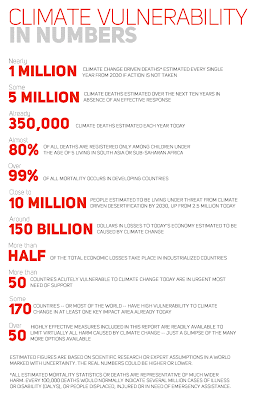
The disaster relief agency DARA provides a chart summarizing the need for prayers and action; especially telling is the heart-breaking
report of who has been the most vulnerable to climate change in recent years.
According to this chart, as of 2010 there were already
350,000 deaths per year attributable to climate change. Of those deaths, nearly
80% were registered among one population: children under the age of 5 living in
South Asia or Sub-Saharan Africa. Links next to the chart provide more
statistics about where we have been and where we are expected to go in this
century. From 2030 on, there are one million deaths per year expected, along
with “several million cases” each year of illness or disability, or people
displaced, injured, or in need of emergency assistance.
The prayers from SAFCEI include a prayer for Rio+20 written by
the Anglican Archbishop of Capetown, Thabo Makgoba. The Rio+20 Conference is the UN Conference on Sustainable Development that will be held in Rio de Janeiro
on June 20-22. The aim of the conference to find agreement on a range of
measure that can reduce poverty while promoting decent jobs, clean energy, and
a more sustainable and fair us of resources. (In the church, we might call this
a stewardship conference.) The conference website says “Rio +20 is a chance to move away from business-as-usual and to act to end
poverty, address environmental destruction and build a bridge to the future.”
The offering of many prayers for the world’s leaders to seek
and find ways to end poverty and address environmental destruction is a good
practice this month and every month!
The last Sunday in May
was Pentecost this year. Pentecost is a fitting time not only to look back at
the gift of the Holy Spirit at the Pentecost described in Acts 2:1-21, but also
to consider how the Spirit calls and empowers the church today to share the
Gospel.
Our Psalm on Pentecost
Sunday (Psalm 104:25-35, 37b) praises God for the earth and for the great
variety of creatures – “O Lord, how
manifold are your works” – and for God’s provision for creation. It’s a picture
of the abundance and biodiversity we would expect to find in the unspoiled
creation of a gracious and loving God.
The Epistle lesson
from Romans 8:22-27 describes human beings and all of creation waiting together
for redemption. Paul talks about hoping for things we cannot yet see, because “hope
that is seen is not hope”.
Surely the Spirit
calls us in the church to be part of God’s redeeming work for the earth as well
as humankind. The world described in Psalm 104 is a picture of the Reign of
God, where even the Leviathan, the serpent of the sea, is something good and
playful. One way to tell whether a push or pull toward action is of the Spirit
is to look at whether it works for or against the restoration of God’s
creation. Even when hope seems slim, we are called to trust in God’s power and
do the redemptive work of the Gospel.
Some of the news
stories from this past month were so devastating that we might very well find
it difficult to pray in response to them. Where do we begin? Our spoken prayers
can seem inadequate. St. Paul says (Romans 8:26): “We do not know how to pray
as we ought, but that very Spirit intercedes with sighs too deep for words.” I
ask your prayers for some of the situations that leave us at the point of
placing much hope in the deep prayer of the Spirit
Acceptance our
repentance, Lord for the wrongs we have done: for our waste and pollution of
your creation, and our lack of concern for those who come after us, Accept our repentance, Lord.
From the Litany of
Penitence (The Book of Common Prayer,
p. 268)
Please pray for:
The future of life on
the earth as greenhouse gas levels rise.
Many scientists consider 350 ppm of carbon dioxide in the atmosphere to
be the upper limit of safe levels of the gas for life as we know it. Today
there were reports that monitoring stations this spring
across the Arctic are measuring more than 400 ppm. Worldwide, levels average
around 397ppm. May also brought a report from the International Energy Agency(IEA) that CO2 emissions reached a record high of 31.6 gigatonnes (Gt) in 2011. This
is a 1.0 Gt increase over 2010 levels.
Wisdom to find just
and compassionate ways to address the economic consequences of climate change. We
are beginning to understand more about the way climate change will affect us
economically. Some are beginning to talk about what scientist and climate
writer Joe Romm calls “Dust-Bowlification”, the expectation that the sort of aridity associated with Dust Bowl may spread
from Kansas to California by mid-century, endangering agriculture and food security.
CBS News ran a piece on assessing the risk of climate change that explored some of the economic effects we have already seen.
People exposed to
toxic chemicals. Discussion of the proposed Safe Chemicals Act has brought our attention to our exposure to toxic chemicals. For example, an
article today reports that chemicals like fire retardants are being detected in common foods. Young
children are especially vulnerable to the effects of these chemicals.
Grateful hearts. Along with some record-breaking heat and
severe weather, May has also brought some beautiful days to be outdoors in
Nebraska. May we continue to find joy and meaning in God’s creation and give
God thanks for the goodness of God’s creation.
We might also pray for our own hearts to be open so we can
see the needs in the world around us and gladly respond to those needs:
O heavenly Father,
who has filled the world with beauty; Open our eyes to behold your gracious
hand in all your works; that, rejoicing in your whole creation, we may learn to
serve you with gladness; for the sake of him through whom all things were made,
your Son Jesus Christ our Lord. Amen.
Prayer for Joy in
God’s Creation (The Book of Common
Prayer, p. 814)
Settlers on the Great Plains had a special appreciation for trees, planting and caring for them so generations to come might enjoy them and have the benefits of shelter from the wind and sun, fruits and nuts, and beauty through the changing seasons. With our tradition of tree-planting in Nebraska, today's meditation (May 23) in Forward Day by Day may be especially meaningful to us.
The author is writing on Isaiah 4:2-6: "[The canopy] will serve as a pavilion, a shade by day from the heat, and a refuge and a shelter from the storm and rain." She writes about the canopies of trees and some of the reasons we should care for trees, suggesting that they have such importance for us that they should take precedence over some other things that more often than not get our attention and our resources:
As we move to include stewardship of the earth and its resources as a mission of the church, we must begin by listening to the voices of the trees and the whisper of the leaves, and not to the voices of the corporations whose only goal is to grow their wealth.
Read the entire meditation here ; follow links for May 23 if necessary. And say a prayer of thanksgiving for a favorite tree!