Saturday, June 29, 2013

Discipleship and Abandoning Business as Usual

Another said, “I will follow you, Lord; but let me first say farewell to those at my home.” Jesus said to him, “No one who puts a hand to the plow and looks back is fit for the kingdom of God.” (Luke 9: 61-62)

As we prepare for our Sunday Gospel reading of Luke 9:51-62, we are hearing about record high temperatures and dangerous heat in the southwestern United States, the most recent widely publicized effect of global warming in the news in our part of the world. In India this week, there were mass cremations of hundreds of people who were killed in floods and landslides two weeks ago. Officials there predict that the final death toll will be more than 1000 people. In Canada, the city of Calgary is beginning what promises to be a long clean-up from flooding. According to this report from the CBC, “the province faces a potentially decade-long cleanup effort that could cost $5 billion by BMO Nesbitt Burns estimates.” President Obama gave a long-awaited major speech about climate change this week.

The reality of climate change is becoming clearer as both the increase in extreme weather events and the necessity of preparing for and mitigating its effects become more visible. “Business as usual” is not a realistic option any more.

In our Sunday Gospel lesson from Luke, Jesus talks about the difficulty of discipleship. When we follow Jesus, we may find ourselves in a place that doesn't feel like home: “Foxes have holes, and birds of the air have nests; but the Son of Man has nowhere to lay his head.”  Good and holy obligations, like burying the dead and saying a proper farewell to family members, are abandoned if they get in the way of discipleship. Following Jesus entails knowing that there are times when conventionally good things get in the way of the best things, the things toward which Jesus points us.

Our way of life as middle class Americans is in many ways the conventionally “good life”. We have secured many of the necessities of life in a way only dreamed of by most people in other times and places. We aren't bad people for living the way we live and enjoying our abundance, especially when we do so with thankful hearts. But knowing what we know now about the consequences of this way of life, especially our use of fossil fuels, helps us see that our conventionally good way of life is getting in the way of the greater good of caring for God’s creation and caring for the people in the world who are being affected first and worst by climate change.

Other Scripture lessons this past week have reminded us that clinging to customs and conventions, holding onto “business as usual”, is usually not the way to live in accordance with God’s will. The Eucharistic reading from Luke (Luke 1:57-80) for The Nativity of Saint John the Baptist on June 24 tells the story of John’s father, Zechariah, breaking the conventions for naming a baby. When the temporarily mute Zechariah writes “His name is John”, everyone is “amazed” at his straying from the convention of naming a baby after a family member. When Zechariah then regains his speech, fear comes over the neighbors. Readings from Acts 6 and 7 later in the week, St. Stephen’s speech to the council, remind us of other times when people later counted among the most faithful followers of God’s will were persecuted for challenging customs and conventions.

Throughout Scripture, we find a willingness to challenge business as usual when necessary part of living faithfully. Being willing to question the ways we use our resources in our homes, businesses, and churches places us in the tradition of faithful disciples. We may very well need to choose between some traditions and customs that are dear to us in order to be faithful followers of Jesus. Our church buildings may need to be different in size and structure, or existing space may need to be used differently. The ways we prepare and serve food, the materials and activities we offer our children and youth, the ways in which we meet or communicate to do the work of the church are all areas that may require a change. And it’s time for the church to look prayerfully at our investments in the fossil fuel industry and consider whether those investments reflect faithful stewardship of our resources. Deciding to divest from fossil fuel companies and re-invest in companies creating new and less harmful ways of producing energy may necessitate some difficult conversations, but may well be one of the ways Christ is calling the church to lead in the 21st century.


Saturday, May 25, 2013

Excuses


Daily Office Reflection

Some days when I've read about the impacts climate change already has on the web of life on our planet, or when I've experienced the extreme or unseasonable weather events of “global weirding”, or when I've heard about what our political leaders and the media deem important and then compare it to the reality of what is unfolding as a result of greenhouse gas pollution, I wonder about our huge capacity for denial and inaction. Most Americans know on some level that climate change is happening and that humankind is responsible for most of the changes in global climate, but that knowledge isn't deep enough to make a difference in our lives. We continue to make long-range plans as if everything will stay the same, we continue to produce and use energy in ways we know are harmful, and we continue to accept the priorities of leaders who bury climate change way down the list of things needing our attention. The disparity between what we know and how we live is so great that it sometimes seems surreal.

Today’s Daily Office lessons bring together two themes that can speak to us in this new world of global warming and also remind us that while this new situation is on a scale we have never before known – truly global and truly life-threatening to all living things -- our often indifferent response to it and the reasons for that indifference are deeply rooted in the human spiritual condition.

The passage from Paul’s First Letter to Timothy (I Timothy 6:6-21) advises being content to have the basics like food and clothing. When we are not content and focus on getting more money to get more than the necessities, we wander away from a focus on the faith and the way of life Christ taught us. “The love of money is the root of all kinds of evil,” says Paul. For those of us who already are among the wealthy in this world, people who like most Americans have much more than the basic necessities, we are “to do good, to be rich in good works, generous, and ready to share.”

It’s easy to see how the love of money from the fossil fuel industry influences our political leaders and keeps us from changing our energy policies as fast and completely as we need to change them to avert the worst of global warming; it’s easy to see how certain politicians and business leaders place the love of money above the love for caring for God’s creation. It’s perhaps not so easy for some of us to see how the love of money lies at many of the excuses the rest of us make for accepting the status quo. That’s where today’s Gospel reading (Luke 14:12-24) can help.

In response to someone at a dinner party exclaiming, “Blessed is anyone who will eat bread in the kingdom of God!” Jesus tells the story about the guests invited to a great banquet making excuses for not going. They are all good excuses; for each, there is something they consider more important that needs their attention. After inviting instead the people who would usually not be invited to such a gathering, and then anyone who could be compelled to go, the host says “none of those who were invited will taste my dinner.” Good things, things we all consider important, provide excuses for not tending to the best thing, ultimately resulting in a great loss for us.

We don’t do the things we might do to advocate for meaningful action on climate change because our busy lives are full of good things to do that seem more important at the moment. We don’t practice environmental stewardship as well as we might in our homes and parishes because there are other things, many of them good and important things, that take priority for us. Surely part of answering an invitation to a banquet in God’s kingdom is living now as if the essential gifts God has given us for life on this planet are worth conserving. Concern for our neighbors near and far who are already suffering from the impacts of climate change and concern for future generations (and for our own future) require us to set aside those good but nonessential things that lull us into existential denial and create the great gap between what we know and how we live. Being content with what we have and listening with honest and open hearts for our own excuses can help our willingness to act be more consistent with the knowledge we have. 

Sunday, May 19, 2013

Hope at Pentecost

This Pentecost morning I preached at Grace Episcopal Church in Columbus, Nebraska, and included some thoughts about what hope might look like in the face of global warming. Here’s an excerpt:

Jesus said, “[God] will give you another Advocate, to be with you forever. This is the Spirit of truth…Do not let your hearts be troubled, and do not let them be afraid.” (John 14: 16,17, 27)

In this morning’s lesson from Romans (Romans 8:12-25), St. Paul says that “hope that is seen is not hope. For who hopes for what is seen?” In other words, if we know that something we desire will happen, we don’t call that knowledge hope. Hope is being mindful of the possibility of something good; it's not the knowledge that something that is definitely going to happen is going to happen. If I know that today is Pentecost, if I see it right there on the church calendar, then it would seem odd to say that I hope that today is Pentecost. I might hope that the weather will be nice on Pentecost or hope that people come to church on Pentecost, but I don’t hope that it’s Pentecost because I know that no matter what the weather or the attendance, today simply is Pentecost.

We might wonder what hope looks like in this century, especially in light of the environmental challenges before us. Last week, the level of carbon dioxide measured in the atmosphere at the Mauna Loa observatory hit 400 parts per million for the first time in human history. Scientists tell us that to prevent catastrophic warming, that level needs to be no higher than 350 parts per million. We are already seeing an increase in extreme weather – drought, storms, floods, extreme temperatures, already seeing a dramatic decrease in the volume of Arctic ice, and already seeing the effects of these things on humans and other living things. I read this week (Geoffrey Lean, The Telegraph) about two villages in Fiji that are moving uphill and inland to escape rising sea levels, leaving behind, as one official put it, the place where “they have stored their history, their genealogy and their very being”.   On the other side of the Pacific from Fiji, the villagers of Newtok, Alaska, are also preparing to move. Newtok is built on permafrost which is no longer permanent; the melting ground is now too unstable to support buildings and roads. There will in future years be fewer and fewer livable places to which we can move. We know that the changes we are already seeing will be with us long-term no matter what we do now; the challenge is to avoid the worst.

We don’t think about all of this much; we at least don’t hear as much about this in the news as we do lesser things, even trivial things.  We aren’t used to having to think about such things, and we don’t know how to think about them. Christians, though, know how to think about hope, and that makes it possible for us to hold all of this and look at it and think about it. What does hope look like now?

Hope is indeed as Paul describes it, even as the whole creation groans in suffering. Hope is what helps us have the will and the energy to do what we can; and we in turn find new hope when we work with others to turn this around, to advocate for cleaner energy sources, to break the silence from our leaders and the media that keeps us from doing what needs to be done. Hope is in the end trust in God’s goodness; it is believing that even if we cannot imagine or envision a good end to the story, God is good. We are Easter people who know that God brings life where we can see only death; we are also Pentecost people who at our best are open to receiving the Holy Spirit, the Spirit of truth, and to acting faithfully in response to the Spirit.

Today is the birthday of the church and a day we gather in joy in the name of God: the Source of All Being, Incarnate Word, and Holy Spirit. Do not let your hearts be troubled, and do not let them be afraid. Amen.

On the road to Columbus this morning


Saturday, May 11, 2013

400 ppm Response


As predicted for the month of May, carbon dioxide levels as measured at the Mauna Loa observatory have reached 400 parts per million for a daily average. An article from the New York Times yesterday reported the discouraged and discouraging reaction of scientists to the news; they note our failure to reverse the upward trend in these readings, the catastrophic results we face from this dramatic change in our atmosphere, and the fact that the last time carbon dioxide levels were this high on the earth, human beings were not yet here.

We know the reaction of the news media: there are some reports about crossing the threshold, including statements from the scientists, but reporters are not giving this the attention we usually give to national catastrophes or calamities. And the reaction so far from the majority of our political leaders is silence.

The Episcopal Church just finished participating in a short conference on “sustaining hope in the face of climate change”.  Our leadership acknowledges the problem. I wonder how many parishes, though, will include special prayers this Sunday after we have reached this mark, how many preachers will feel a need to address this the way we have addressed 9/11 or mass murders or large scale natural disasters, how many people visiting at coffee hour will talk about their feelings about this being the week we reached a reading of 400 ppm.

The church has an opportunity to break the great silence of the media and political leaders; the church has an opportunity to do what our faith equips us to do best, to help people look at the reality of what is happening and process its meaning and go out prepared to deal with this new world with its new needs. The church can recognize this and name this for what it is: a tragedy, a worldwide emergency, a shared grief.

When The Book of Common Prayer was written in 1979, a small number of scientists were beginning to get an idea of where we were headed with greenhouse gases and climate change. Most of us knew nothing about any of this, though, and our prayer book has no prayers or collects for reaching unthinkable thresholds of atmospheric concentrations of carbon dioxide. We do, however, have many prayers for people in need of healing and food and water, for the welfare of our nation and the world, for our leaders, and for our own strength and courage and wisdom. We can pray these in light of where we are now, mindful of new needs in the world and old needs of human souls that got us where we are now and can also repent and get us headed in a better direction.  And we have prayers such as these:

For the Conservation of Natural Resources
Almighty God, in giving us dominion over things on earth you made us fellow workers in your creation: Give us wisdom and reverence so to use the resources of nature, that no one may suffer from our abuse of them, and that generations yet to come may continue to praise you for your bounty; through Jesus Christ our Lord. Amen. (p. 827)

For the Future of the Human Race
O God, our heavenly Father, you have blessed us and given us dominion over all the earth: Increase our reverence before the mystery of life; and give us new insight into your purposes for the human race, and new wisdom and determination in making provision for its future in accordance with your will; through Jesus Christ our Lord. Amen. (p. 828)

And so that we might preach the truth and be mindful of our priorities, remembering that nothing less than our own future and the future of our children and grandchildren are at stake and that Christ gives us the strength we need to do the work before us, we might pray for the church:

Gracious Father, we pray thy holy Catholic Church. Fill it with all truth, in all truth with all peace. Where it is corrupt, purify it; where it is in error, direct it; where in any thing it is amiss, reform it. Where it is right, strengthen it; where it is in want, provide for it; where it is divided, reunite it; for the sake of Jesus Christ thy Son our Savior. Amen. (For the Church, p. 816)

There is so much beauty in the living things around this; aware of what we may lose yet in our lifetimes, sharing our love for the beauty of the earth and thanking God for these gifts is also part of our prayer:


Monday, May 6, 2013

"Do we want to be made well?" addendum

399.68

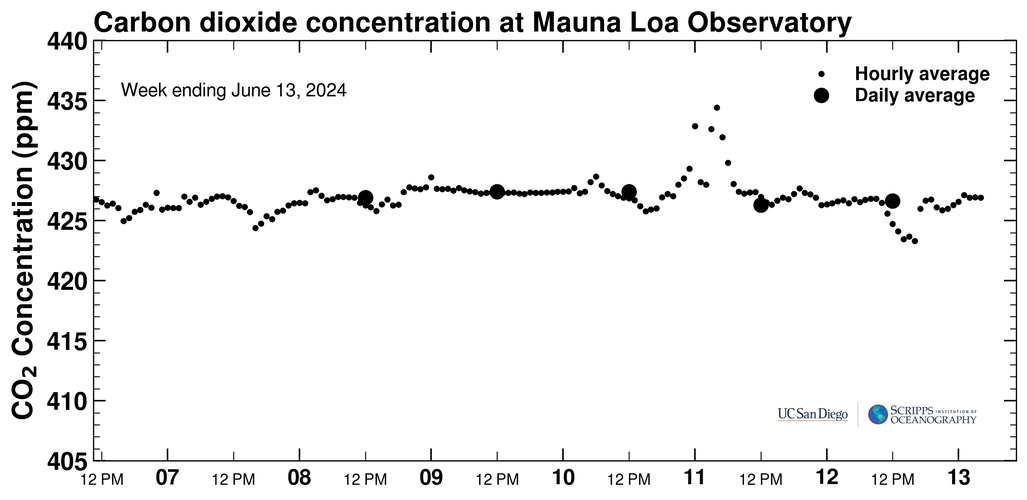
399.68 ppm was the May 4 daily average reading for atmospheric carbon dioxide.  The Keeling Curve: A Daily record of Atmospheric Carbon Dioxide from Scripps Institution of Oceanography at UC San Diego posts the latest reading along with various historical charts to help in understanding the significance of the current number.

The chart for the past week shows that some hourly readings already had reached 400 ppm.

From http://bluemoon.ucsd.edu/co2_400/mlo_one_week.png

It may well be that this week, with the "Do you want to be made well?" question from Sunday's Gospel (John 5:1-9) still fresh in our thoughts, that we will hit 400 ppm for a daily average.

The Keeling Curve website includes a page describing What Does 400 ppm Look Like? .  The last time carbon dioxide levels were  this high was during the Pliocene period (3 to 5 million years ago). This is the first time in human history that carbon dioxide levels have been this high; we have changed our biosphere in a way we are only beginning to understand. What we know about temperatures and sea levels in the Pliocene period can help us understand what we may be experiencing.

Here's a spiritual exercise for today: Ground yourself in prayer and Christian hope and take a look at what 400 ppm looks like, then decide your answer to the question: "Do you want to be made well?"

Sunday, May 5, 2013

Do we want to be made well?


6th Sunday of Easter and 400 ppm CO2

“Do you want to be made well?” is the question Jesus asks in the story in John (John 5:1-9)  about the healing of the man who had been lying next to the pool by the Sheep Gate for 38 years. Unlike other stories of Jesus healing people, neither this man nor anyone else acting on his behalf approaches Jesus or calls out to him to ask for healing. Instead, Jesus approaches him and asks, “Do you want to be made well?”

In answer, the man offers an explanation of why he has not been healed: he has no one to help him be the first one to get in the water when it is “stirred up” and thought to have healing properties. After 38 years of this, he doesn't sound as if he has any expectation that he will ever make it into the pool at the right time, and yet he keeps doing the same thing day after day. Could he not imagine any other alternative?

Jesus gives him an alternative, and in giving the alternative, also gives him his healing. Jesus doesn't lay hands on him or pray over him or cast out demons. Instead, Jesus simply tells him to get up, pick up the mat he has been lying on all these years, and walk.

As May begins, we are hovering around atmospheric carbon dioxide levels of 400 ppm. The home page of CO2Now.org shows this graphic today:


The level of atmospheric carbon dioxide scientists tell us we need to reach for climate stability that supports life as we have known it on the Earth is 350 ppm. (See the CO2 Now website or 350.org for more information about that number.)

These readings are taken at the Mauna Loa observatory in Hawai’i. Ralph Keeling, a geologist at the Scripps Institute of Oceanography that operates the observatory, said, “I wish it weren't true but it looks like the world is going to blow through the 400ppm level without losing a beat.”

On the Climate Progress blog today, Joe Romm’s post Into The Valley Of Death Rode The 600, Into The Valley Of 400 PPM Rode The 7 Billion compares our staying on a “self-evidently suicidal” path to the charge of the British light cavalry in the Crimean war that Tennyson remembered in The Charge of the Light Brigade.  Romm writes:

Certainly as we hit 400 parts per million (ppm) for the first time in human existence, with not even a plan to avoid 600 ppm, 800 ppm, and then 1000 — not even a national discussion or an outcry by the so-called intelligentsia – it is worth asking, why? Is there something inherent in homo “sapiens” that makes us oblivious to the obvious?

Along with those questions, we might ask ourselves the question Jesus asked the man by the pool: Do we want to be made well?  This is a question about our priorities. Choosing health over sickness, holiness over sin, life over death is really a matter of putting first things first.  The things that help us continue to grow toward greater wholeness and the fullness of life that God desires for us are not always the comfortable or convenient things or the familiar things. It’s usually easy to find excuses for not doing the right thing; when we choose to stay stuck instead of making the effort to move forward, we can rationalize that choice so well that we often manage to convince ourselves that staying stuck is our only option or the best option or even the right thing to do. This time the consequences of staying stuck are the most far-ranging and dire we have ever approached.

We know that changing the trajectory of our carbon emissions will require some significant changes in the way we do things. Even though what we are doing is making climate change worse and worse, doing something about it, especially doing anything that requires political courage or inconvenience or change of any sort is not a priority for very many people. Doing the deep spiritual work of really seeing what we are doing to our planet, ourselves, and all living things and keeping ourselves spiritually whole and grounded in faith as we figure out how to respond seems to be an especially low priority.

Do we want to be made well? Do we want to change the path we are on? The choices are either to continue just what we are doing, or to get up and walk into a very different but healthier future.

At the beginning of May, Episcopal Church Presiding Bishop Katharine Jefferts Schori, Church of Sweden Archbishop Anders Wejryd and ELCA Presiding Bishop Mark Hanson signed a statement celebrating a commitment to hope in the face of climate change. The statement includes a commitment to “walk a different course”:

As Christians, we do not live in the despair and melancholy of the tomb, but in the light of the Risen Christ. Our resurrection hope is grounded in the promise of renewal and restoration for all of God’s Creation, which gives us energy, strength and perseverance in the face of overwhelming challenge. For us, this promise is more than an abstraction.  It is a challenge to commit ourselves to walk a different course and serve as the hands of God in working to heal the brokenness of our hurting world.

Scientists, engineers, economists, and political leaders are better prepared to address big pieces of the work we must do if we are to cut carbon emissions enough to make a difference. People of faith can offer a new kind of hope. Perhaps most importantly, we can ask the important question, “Do we want to be made well?” and empower ourselves and others to get up and do the work that needs to be done.


Sunday, April 21, 2013

Faith in Action: Comment on Keystone XL Pipeline


Tomorrow is Earth Day; in our liturgical calendar, today was the Fourth Sunday in Easter. In the Gospel reading for today (John 10:22-30), Jesus answers a question about whether he is the Messiah by pointing to his actions: “The works that I do in my Father’s name testify to me”. He goes on to talk about his followers, his “sheep”, those who know who he is. Jesus says his sheep hear his voice and follow him. Just as Jesus’ identity was revealed in his actions, our identities as Christ’s own are revealed in our actions, in our following him. Our actions are important.

Tomorrow is also the deadline for submitting comments to the State Department about the proposed Keystone XL pipeline. Many people testified in opposition to the pipeline before a State Department hearing in Grand Island on Thursday. Written comments are still being collected.

Bold Nebraska has a page devoted to collecting comments to send to the State Department; the page includes links to background resources to help find a focus for your statement and check the facts before writing, and also includes a form that makes it easy to submit a comment.

Anyone can submit a comment. Doing so would be a fine way to observe Earth Day, and doing so to defend the integrity of God’s creation and the welfare of God’s people is a fine way to put our faith into action.

My statement is centered on moral and spiritual issues; others are writing about particular concerns about the impacts on land, water, and agriculture, about landowners’ rights, and about other issues. Focus on whatever piece of this project strikes you the most. Here’s what I wrote:

Statement of Opposition to the Keystone XL Pipeline
  
I’m a resident of Hastings, Nebraska and an ordained deacon in the Episcopal Church serving as Deacon at St. Stephen’s Church in Grand Island, Nebraska, and as Archdeacon of the Diocese of Nebraska. My general area of ministry is environmental stewardship and how that connects with our spiritual and physical well-being. As the amount of carbon dioxide in our atmosphere increases, the amount of Arctic sea ice decreases, and as we continue to extract more fossil fuels from the earth, my ministry focuses increasingly on the moral and spiritual aspects of the climate crisis caused by our ongoing use of fossil fuels. The effects of climate change, including droughts, extreme weather events, rising sea levels, and melting permafrost all have ill effects on people, often on some of the poorest people in the world who can least stand these added stresses. These effects along with the disregard for the integrity of God’s creation bring this argument into the sphere of religion and ethics.
 
Our existential denial of global warming – accepting the science intellectually but going on with life as if climate change were not happening – is one of the puzzling responses that point to a spiritual danger.  If we know what causes global warming and what we need to do to mitigate its effects and how very soon we need to stop burning fossil fuels, how can we even entertain the thought of building something to enable the release of the amount of carbon in the Alberta tar sands? What does the fact that we are considering approving the project say about the state of our souls and the state of our national climate policy?  The very real effects of extracting, processing, and burning the tar sands on humans and on the ecosystems that sustain all life on this planet is reason enough to deny a permit for construction of the Keystone XL pipeline.
 
Reading the Environmental Impact Statement, I’m struck by a sense that this study was carried out in a state of existential denial about climate change and many other things. That there are real people living in Nebraska whose livelihoods depend on the integrity of the land and water that they have conserved and protected for generations because their lives depend on doing so seems to be another reality that is ignored. It’s as if the EIS were developed in a world where fossil fuels area the ultimate good, the only thing worth considering, while they are in fact the biggest threat to the future of humankind.
 
We are well aware that there are always people who will do just about anything – even sell their own souls – if they’re offered thirty pieces of silver, even if the offer of the silver turns out to be an empty promise. I’m proud to live in a state where our ranchers and farmers keep their priorities straight and stand up for the stewardship of our land and water that Nebraskans have practiced for generations. The land and water not only sustain our agricultural economy, but they ground us spiritually. The threat of this pipeline to our land and water is reason enough to deny a permit for construction of the Keystone XL pipeline.
Even though people opposed to the pipeline talk about climate, the Ogallala aquifer, the fragile Nebraska Sandhills ecology, tribal rights, and the rights of landowners, when we talk about a project of this nature we are in the end talking about ultimate things. We usually look to theology to figure out what we believe about ultimate things, but when we consider projects that put profits and the possibility of some short-term gains for a few ahead of all else while pushing the agricultural economy of Nebraska and the survival of life as we have known it on this planet toward the brink of disaster, we can look at our political decisions to learn about our true beliefs about ultimate things. It comes down to a moral question, perhaps the most important moral question humankind has ever had to ask ourselves: Will we set aside business as usual and do all we can to mitigate the warming of our planet, or will we continue to act as if the will of the fossil fuel industry is the ultimate authority in our lives?
 
We have a choice to make between death and life. Deny this permit and choose life so that we and our descendants may live.


Respectfully submitted,

The Ven. Betsy Blake Bennett
Hastings, Nebraska