Saturday, December 28, 2013

Holy Innocents

Today is the Feast of the Holy Innocents. Below is a reposted reflection on the day from last year. Children remain especially vulnerable to the impacts of pollution and climate change. The future of every child in the world is threatened by climate change, and we continue to place a low priority on addressing that threat. Last year's reflection ended with a video of the The Coventry Carol in honor of the innocents who died in Typhoon Sendong in the Philippines in 2011. This year I've shared another video of The Coventry Carol to honor the innocents who died this year in Typhoon Haiyan and in wildfires, floods, tornadoes and hurricanes and other extreme weather events this year.
***

We remember today, O God, the slaughter of the holy innocents of Bethlehem by King Herod. Receive, we pray, into the arms of your mercy all innocent victims; and by your great might frustrate the designs of evil tyrants and establish your rule of justice, love, and peace; through Jesus Christ our Lord, who lives and reigns with you in the unity of the Holy Spirit, one God, for ever and ever. Amen.  Collect for Holy Innocents, Book of Common Prayer, p. 238

Pollution and the effects of climate change impact children especially hard. Pollutants generally do more damage to developing bodies; dehydration from diarrheal diseases caused by lack of clean water is especially dangerous for infants and young children. According to World Health Organization information about climate change and health, “children – in particular, children living in poor countries – are among the most vulnerable to the resulting health risks” from climate change”. Among these risks are extreme heat, malnutrition, lack of clean water, impacts of natural disasters, and increasing risk of diseases such as malaria, dengue fever, and diarrheal diseases.

Today the church remembers the Holy Innocents, the children who died when Herod ordered the slaughter of all children who were two years old or younger (Matthew 2: 13-23). Augustine of Hippo called these children “buds, killed by the frost of persecution the moment they showed themselves.”

As air and water pollution and climate change take their toll of young lives, many children in our world never get a chance to be more than buds, buds killed in this case by the frost of the world’s indifference the moment they showed themselves.

The people with power in this world – the political leaders, the economically comfortable, the corporate heads – differ from Herod, of course. Their intention isn’t to cause the death of thousands of children; their intention instead is to maintain political power by not addressing a difficult problem, or to ignore the effects of climate change so that we can continue enjoying the sorts of comforts and conveniences to which we are accustomed, or to make a profit producing, selling, or investing in fossil fuels. Children are the collateral damage of our failure to control pollution and address climate change. There is no intention to harm, but instead of an intention to protect children, there is indifference and denial.

When we look the other way and refuse to acknowledge what is happening as a result of our failure to control pollution and address climate change, we aren’t really all that different from Herod. And the grief of the mothers of today’s innocent victims is no different from the grief of the mothers of Bethlehem some two thousand years ago.
***

Here is the Coventry Carol in honor of all the innocents killed by greed and indifference:


Friday, December 27, 2013

Joy: Day 3

Joy to the world! The Lord is come: let earth receive her king;
Let every heart prepare him room, and heaven and nature sing.

With “Joy to the world” in our hearts and minds, I invite you to join me in looking each of these twelve days for instances of the joy that runs through all of creation, especially through experiencing the beauty and wonder of God’s world.


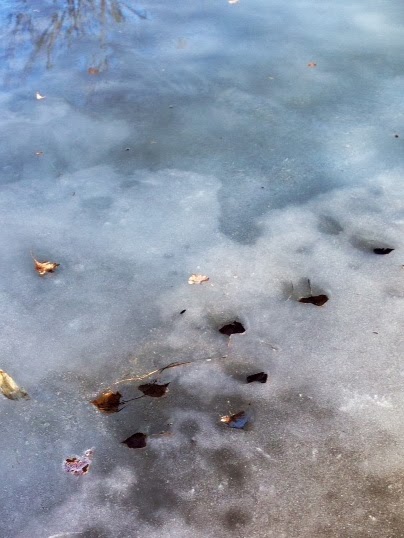
Temperatures above 50 degrees today in our part of Nebraska along with a good dose of midday sun helped it feel very comfortable outside despite a fairly good breeze. In the afternoon, we walked at a lake where whatever ice had formed earlier was melting. Leaves that had been caught in the top of the ice when it had frozen had absorbed enough heat from the sun to begin melting the ice around each leaf.

It’s such an elegantly simple example of something all of us who have lived with ice and snow know, that darker surfaces absorb heat from the sun and speed the thawing of ice and snow around them. This is why the melting of Arctic ice has produced a feedback loop that has accelerated the melting: as ice melts, open water is exposed. The open water absorbs heat from the sun that would be reflected by ice. As more heat is absorbed, the melting of the ice is accelerated.

There’s some joy in knowing that we understand a lot about the science of climate change. Should the powers that be ever decide to do something significant to mitigate climate change, scientists can help to maximize that effort. But the beauty of each little depression slowly growing as the sun shone was the surest and most immediate joy, wonder enough for today.


Joy to the world! The Savior reigns; let us our songs employ, while fields and floods, rocks, hills, and plains, repeat the sounding joy.

Thursday, December 26, 2013

Christmas Joy: Days 1 and 2

Joy to the world! The Lord is come: let earth receive her king;
Let every heart prepare him room, and heaven and nature sing.

Christmas, the Feast of the Incarnation, is a joyous remembrance of the Word made flesh. Christ is born in the world! The creation of God the Creator becomes the holy dwelling place of the Incarnate God, affirming that while God transcends all of creation, God is not removed from creation. God chooses to be among us, and all of creation sings with joy!

With “Joy to the world” in our hearts and minds, I invite you to join me in looking each of these twelve days for instances of the joy that runs through all of creation, especially through experiencing the beauty and wonder of God’s world.

Here are some of the joys I've experienced the first two days of Christmas.

Christmas Day: We gather green things and flowers to decorate our churches and homes at Christmas. This time of year in the cold parts of the world, flowers bring great joy to us. Church of the Resurrection in Omaha used poinsettias on the altar and a symbolic star above it all to bring some of the joy of the outside world into our sanctuary for Christmas Eve. At home, a gift of flowers brought us the joy of color and beautiful smells.


Second Day of Christmas: Mild weather in our part of Nebraska today made it easy to notice bits of green among the browns and grays that dominate our December landscape. A close-up of an ivy leaf shows a creamy white color and a surprisingly bright rose-colored stripe along with the green. This same ivy on our walls provides shelter for some hardy wrens that have been singing on sunny winter mornings.


Joy to the world! The Savior reigns; let us our songs employ, while fields and floods, rocks, hills, and plains, repeat the sounding joy.

Sunday, December 22, 2013

Advent IV: Deeper Traditions

 This reflection for the Fourth Sunday of Advent is a revision of a post from December 18, 2010 that was written after the UN Framework Convention on Climate Change held in Cancun that year. It also referenced the 2010 Climate Vulnerability Monitor, which remains a good resource to help in understanding the effects of climate change on various parts of the world.


Matthew’s account of the birth of Jesus (Matthew 1:18-25) tells the extraordinary story not only of Mary’s pregnancy and the birth of Jesus, but of Joseph’s reaction to the news. Joseph’s righteous response to Mary’s pregnancy was as plan to dismiss her quietly and shield her from public disgrace; such a reaction was enough out of the ordinary to warrant comment from Matthew. Then Matthew reveals the most unexpected piece of Joseph’s story: in a dream, an angel spoke to him, and when he woke up, Joseph did as the angel commanded him.

The nativity story is Good News; it’s a story of something new and different, a story of new life coming into the world on a very deep level.

Despite our celebration of the newness of the birth of Jesus, we tend to cling to traditions, often more so at Christmas than at other times of year. Every year, self-help writers encourage people to let go of traditions that have become burdensome in some ways – a big holiday dinner or party, for example, that has become more work and expense than the hosts can bear -- and try something new that is more life-giving.

Thinking about our environmental footprint at Christmas involves thinking about our traditions on a deeper level. Choices about which gifts to buy, how (or whether) to wrap them, travel plans, food, decorations, all involve examining customs or traditions and considering changing them because we want something that matters more to us: a sustainable future, life.

The environmental challenges we face year-round call for us to examine our daily customs and traditions, our entire way of life, and find other ways to live that make new life possible. They call for us to let go of things that have become burdensome to all living things and try something new that is more life-giving. They call us to move from traditions on the level of familiar customs to traditions on the level of our most essential values.

This blog’s post for Advent III talked about visions of hope and about some signs of change that support us 
in our hope, from the shutdown of some big coal-fired power plants to the little wind- and solar-powered “energy barn” built in the path of the Keystone XL pipeline here in Nebraska. While these things alone don’t put much of a dent in global warming, they are a start, and they do give us hope that bigger things can done that could significantly mitigate global warming.

Doing something is preferable to doing nothing, and signs of hope are something to celebrate, but some welcomed steps in the right direction aren’t the same thing as justice, especially not justice as described by the prophets. For the people on islands that are threatened by sea level rise, for people trying to raise enough food to survive in places where the traditional planting and harvest dates no longer are reliable, or for people who have lost homes or loved ones to severe weather events, changes on a much deeper scale is needed. What counts as a successful nod to the climate crisis in the political world, or what we might see as a success because it gives some small glimmer of hope in the darkness, isn't necessarily success according to the standards of the prophets.

Real justice calls us to change our way of life so deeply that the earth, worn down like the poor by our greed and selfishness, can be renewed and restored. These sorts of deep changes require an essential spiritual component that our deepest traditions can provide if we will tap into them. These sorts of deep changes are embedded in the story of the birth of Jesus, the story we prepare to celebrate this week. If we stop and listen to Matthew’s account of the birth, letting the story reach our hearts as well as our ears, we may find ourselves prepared to embrace those deep changes with gladness. We may find Good News, a story of new life coming into the world on a very deep level.


Tuesday, December 17, 2013

Unholy Silence

The noon Eucharist at Trinity Cathedral in Omaha today used the propers for 19th-century abolitionists William Lloyd Garrison and Maria Stewart. Shortly before going to the chapel for Eucharist, I read a disturbing piece by Kieran Cooke, Reigniting the climate change debate, about climate change communication. Among studies it referenced was a Yale University survey that found that “only 8% of respondents said they communicated publicly about climate change, while nearly 70% said they rarely or never spoke about it.”

What really struck me about this piece, though, was an account of George Marshall’s description of his efforts to engage people in conversation about global warming. Marshall is a co-founder of the Climate Outreach and Information Network (COIN) in the UK, an organization that specializes in climate change communication. Marshall says he always tries to introduce the topic casually --  “after all,” he says, “no one wants to find themselves sitting next to a zealot on a long-distance train journey.” He continues:

 But I need not worry because, however I say it, the result is almost always the same: the words collapse, sink and die in mid-air and the conversation suddenly changes course…it’s like an invisible force field that you only discover when you barge right into it. Few people ever do, because, without having ever been told, they have somehow learned that this topic is out of bounds.

I know this experience very well. It does seem that global warming /climate change has become something one does not discuss in polite company. [i]How is it that the issue that will have the most impact on human life in the 21st century has become unmentionable in polite company? And how do we respond? Do we keep our silence because speaking about climate change makes people uncomfortable, or do we ignore the social taboo and speak plainly because our very lives depend on our thinking about climate change and talking about climate change and figuring out how best to live given its reality?

With this on my mind, when Dean Loya shared the stories of William Lloyd Garrison and Maria Stewart finding ways to communicate the urgency of the need to end slavery in the United States, their words resonated with me. Evidently William Lloyd Garrison was criticized for being too “severe” in his language; it seems he was expected to be politely moderate about ending human slavery. The Lectionary website shares this quotation from the first issue of Garrison’s anti-slavery newspaper The Liberator:

I am aware that many object to the severity of my language; but is there not cause for severity? I will be as harsh as truth, and as uncompromising as justice. On this subject, I do not wish to think, or to speak, or write, with moderation. No! no! Tell a man whose house is on fire to give a moderate alarm; tell him to moderately rescue his wife from the hands of the ravisher; tell the mother to gradually extricate her babe from the fire into which it has fallen; – but urge me not to use moderation in a cause like the present. I am in earnest – I will not equivocate – I will not excuse – I will not retreat a single inch – AND I WILL BE HEARD. The apathy of the people is enough to make every statue leap from its pedestal, and to hasten the resurrection of the dead.

Like slavery, climate change is an issue that impacts too many human lives too terribly for us to sit by quietly and allow it to happen. What will the people still living at the end of this century think if they have a way of knowing that politeness kept us from doing what we could have done? And how are we the Body of Christ if we allow politeness to trump alleviation of human suffering and the deaths of entire species of animals and plants?

[i] Holiday social tip: Unless you really want to know what work engages the people you meet at holiday parties, don’t ask. Some of us are engaged in some form of climate activism, and if the conversation dies the moment we reveal what it is that we do, it’s hard to keep up social chit-chat. Similarly, if an intelligent observation about what’s making our weather so strange this winter is something you would find socially embarrassing, don’t wonder aloud about what the cause might be, as there might be someone at the party who knows the answer.


Sunday, December 15, 2013

Advent 3: Visions of Hope

The wilderness and the dry land shall be glad, the desert shall rejoice and blossom; like the crocus it shall blossom abundantly, and rejoice with joy and singing. The glory of Lebanon shall be given to it, the majesty of Carmel and Sharon. They shall see the glory of the Lord, the majesty of our God. Strengthen the weak hands, and make firm the feeble knees. Say to those who are of a fearful heart, “Be strong, do not fear! Here is your God. He will come with vengeance, with terrible recompense. He will come and save you.” (Isaiah 35:1-4)

Jesus answered them, “Go and tell John what you hear and see: the blind receive their sight, the lame walk, the lepers are cleansed, the deaf hear, the dead are raised, and the poor have good news brought to them. (Matthew 11:4-5)

Each week seems to bring new information about climate change, its effects, and the pace at which those effects are unfolding. How hopeless is it?

This week’s climate news included a report of a research project by a US Navy scientist that predicts an ice-free Arctic Sea by fall of 2016 (plus or minus three years -- which means sometime between now and 2019). How hopeless is it?

We know we have passed the point where lowering our emissions of greenhouse gases can prevent global warming. The warming that has already taken place has set feedback loops in motion that will cause some level of warming to continue even if we suddenly do the politically improbable and manage to lower the level of greenhouse gas emissions by a significant amount. The aim now is mitigation: lessening global warming and its effects as much as possible given the physical and chemical reality of our situation. 

Sign on the way to church last Sunday
Our lesson from Isaiah (Isaiah 35:1-10) for the Third Sunday in Advent describes a beautiful time when all of nature is full of joy, when flowers bloom in the desert and God’s unmistakable presence fills the world. It describes not a picture of what is but a vision of God’s possibilities. The prophetic visions of Scripture came to men and women well aware of the realities of their times and places. There are words of warning as well as words of promise. The visions were not a denial of reality; instead, they were rooted in that reality, a reality that the prophets saw more clearly than those around them. The prophetic visions provided a dream of new possibilities and an ideal by which to measure the present reality. The prophetic visions were an opening up of a new reality that could begin to unfold if people radically changed their way of life and returned to true worship that would remove the internal and external barriers to the unfolding of the vision.

While visions of hope are hard to find in climate science reports that document an accelerating warming and predict catastrophic results if we remain on our current path of greenhouse gas emissions, there are signs of change. In Jesus’ time and place, there was plenty of sickness, poverty, and oppression even though Jesus was healing. John the Baptist asks whether Jesus is the one they've been waiting for or if there is another. Jesus says (Matthew 11:4), “Go and tell John what you hear and see”, and lists signs of hope. We can look at signs of something changing – e.g. several coal-fired power plants shut down various places including Massachusetts and Chicago, solar energy use on the increase worldwide, decreasing use of automobiles in younger Americans, the wind- and solar-powered barn built in the path of the Keystone XL pipeline here in Nebraska. These things alone aren't enough to prevent catastrophic warming, but they may be signs of bigger changes that are coming to be.

This Third Sunday of Advent there is hope. We don’t know what shape hope takes in our generation. Authentic hope is not naïve; hope doesn't say everything will be fine, and it certainly doesn't say that everything will be just the way it was before humankind spewed enough greenhouse gases into the atmosphere to warm the planet to the point where feedback loops accelerate the warming.

Our hope means that we know that God is with us and God is faithful. It means that there is a bigger picture we simply cannot see from our little corner of the universe and our tiny point in history. It means that there are visions of what might be that we might be able to see if we turn away from our accustomed way of living and open ourselves to something new. As we are reminded especially during Advent, hope means God is with us no matter what.


Saturday, December 7, 2013

Protecting our children and nature: fruit worthy of repentance

Advent 2

For the Second Week of Advent, two very different but related texts can help us be better prepared to celebrate the birth of Jesus and to receive Christ in our hearts at Christmas.

The first text is this week’s Gospel lesson from Matthew 3:1-12 about John the Baptist appearing in the wilderness and proclaiming, “Repent, for the kingdom of heaven has come near.”

The second text is a new report from eighteen of the world’s top climate scientists entitled Assessing ‘‘Dangerous Climate Change’’: Required Reduction of Carbon Emissions to Protect Young People, Future Generations and Nature. This report is well worth reading in its entirety, but there is also a summary  available. The summary explains that the paper “was initiated to provide the scientific basis for legal actions against national and state governments for not doing their job of protecting the rights of young people and future generations.” In doing so, it also helps lay the groundwork for a moral argument against our complacency as some of the wealthier people on the planet in the early part of the 21st century.

The paper argues that the 2° C warming that world climate forums have talked about as a limit that would prevent catastrophic climate change is too high a limit. (It should also be noted that several scientists think we are already on track to surpass that limit because of amplifying feedbacks.) This paper argues that 2° C warming creates instability that makes it impossible to stay at the two degree limit; two degrees of warming creates “slow feedbacks” that eventually lead to 3-4° C of warming. A simple example of feedback is the melting of the Arctic sea ice. Ice and snow reflect fairly large amounts of sunlight. When the ice melts, there is more open water and less ice, which means more sunlight is absorbed, which leads to more warming. This of course leads to further melting, which leads to further warming, and so forth. They argue that reducing global carbon emissions to 350 ppm by the end of the century can keep us within a warming limit that prevents catastrophe. And they note that “there is still opportunity for humanity to exercise free will”.

I love the beauty of our worship at Christmas, and I love the beauty and wonder of the Advent season that leads up to our great celebration of the Feast of the Incarnation. But my heart hurts when I realize how far from the mark of following Christ we can be when we focus more on the form and aesthetics of our worship than we do on our call to follow Christ. In this Sunday’s Gospel, John the Baptist says that it doesn’t matter if people are good religious folks – children of Abraham – if their lives don’t show it. “Bear fruit worthy of repentance” says John.

I hope that as we gather in churches on Christmas Eve that somewhere in a homily or in the prayers we name the reality and urgency of climate change. I hope that when we think about and speak about the Incarnation that we appreciate the depth of that mystery by looking at the reality of our world where God has chosen to come and dwell with us. I hope that as we prepare for the birth of the Holy Child and then celebrate the birth, and as we prepare to enjoy and delight the children we know and love, that we care enough about both the Christ-child and our own children to bear fruit worthy of repentance and work as hard as we can to stop the burning of fossil fuels and be willing to change the way we do things so that future generations might live.